The Dictionary Defense
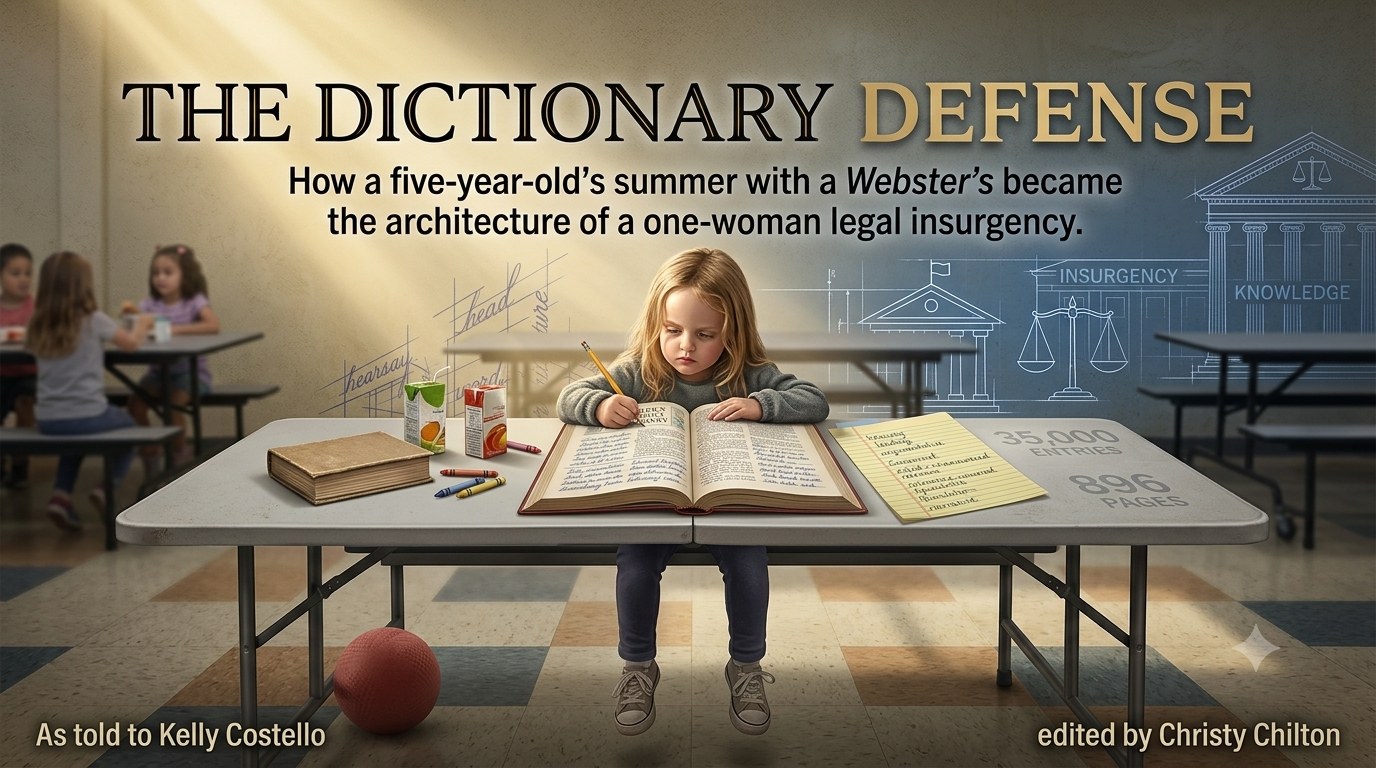
How a five-year-old's summer with a Webster's became the architecture of a one-woman legal insurgency
As told to Kelly Costello, edited by Christy Chilton
There is a particular kind of Florida heat that doesn't so much arrive as settle — a wet weight that presses itself into upholstery, into hairlines, into the small ambitions of children sent outside to play.
In the summer of 1989, inside a YMCA whose air conditioning wheezed like a chain-smoker's last gasp, a five-year-old girl named Christy Chilton was not outside. She was at a folding cafeteria table, feet swinging well above the linoleum, copying a dictionary into a notebook by hand.
Not reading it. Copying it. All 35,000 entries, all 896 pages, in the obedient yet still unfamiliar handwriting of a child who has decided, for reasons she still cannot fully articulate, that this is the task in front of her, it feels important and it will be finished.
Around her, the other children were doing what children in Sunny St. Petersburg, Florida do at Summer Camps in July — turning the playground into a minor economy of dares and grudges, mastering the diplomacy of kickball teams and monkey-bar hierarchies.
Chilton had found something she liked better: a paperback Webster's Children's Dictionary, dog-eared into softness, water-stained, sitting between the half-empty juice boxes with the unglamorous good fortune of being exactly where she needed it to be. It was, by any reasonable appraisal, worth less than the gum stuck under the cafeteria tables. It was also, it turns out, a lockpick.
"There were 35,000 entries in those 896 pages," she says now, thirty-seven years and one emerging law career later, with the specific, slightly amused precision of someone who has recited this number before and still finds it a little unbelievable. "I couldn't tell you which words mattered most; I hadn't lived enough yet to know what half of them meant. But there was an energy—a feeling that resonated in those unfamiliar words and definitions. I couldn't piece together exactly what it all meant, but I knew it was something that maybe I could have. Though contextually vague to me then, I felt a profound sense of possibility, a kind of hope for what was coming. When I think about a few of those moments, I can still feel that resonance and uplifted intrigue in my heart today."
It is tempting, and probably too easy, to call this the origin story. Childhoods don't organize themselves into narrative arcs on command; a five-year-old with a No. 2 pencil is not yet plotting a life. But origin stories earn their keep only when the thread holds all the way through — and in Chilton's case, it holds clean to Courtroom 3C of the Sarasota County Courthouse, thirty-five years later, where she is standing at counsel table doing, with considerably higher stakes, more or less the same thing: taking language that other people treat as furniture and turning it into leverage.
"In retrospect, I suppose that confirms this was the beginning of my lifelong love, passion, and respect for knowledge," she says. "And my deeply ingrained belief that knowledge is absolute power — for anyone, no matter your socioeconomic status, environment, or background. Being able to recall that feeling so intensely today only reaffirms that this was, in fact, a profoundly significant moment in my life, despite being only five years old. But damn, it meant something then. It still means something now."
She arrives dressed like someone who understands that a courtroom is also a stage, and that the wardrobe is part of the argument. The suit is Theory, precise rather than merely expensive-looking—tailoring that reads less like look how cute my outfit is and entirely like I am here to verbally dissect your arguments with surgical precision.
Her manicure is immaculate in the specific way that reads less like vanity and more like armor — the visual equivalent of a closed fist raised against a history that once threatened to end her. It is worth noting, because the opposition across the room has clearly not thought about any of this, and it shows: the $400-an-hour attorney fidgeting with her Montblanc pen, her bland, unflattering, still-technically-designer suit suddenly feeling like tissue paper dressed up as armor.
Her table tells its own story, and it is not a tidy one. Four hundred-some pages of exhibits, annotated, color-coded, cross-referenced with the obsessive granularity of someone who learned early that surviving a chaotic system means knowing where every landmine is buried before you take a step. It is, without exaggeration, a war room that would not embarrass the Pentagon — the kind of exhaustive documentation you'd expect from someone who had once catalogued 35,000 dictionary entries for no reason anyone could explain to her at the time, and every reason that makes sense now. It has the same meticulous, unglamorous focus that made Ruth Bader Ginsburg a legend, except the stakes here have nothing to do with legal commentary and everything to do with survival.
Opposing counsel, for her part, has the specific, unearned confidence of someone who has never had to prepare for a fair fight—"the kind of unearned, empty privilege," Chilton notes with dry precision, "so pungent that you can smell from across the room. It’s like someone dumped an entire bottle of $12.99 drugstore Jovan Musk over themselves, ignorantly blind to their own lack of taste, operating on a misguided confidence that only nepotistic backing and lazy privilege provides.”
Tucked away in this battlement of briefs, motions, and exhibits is an absolute tell of Chilton's grit — hidden beneath the vast array of color-coded perfection, easy to miss if you didn't know to look for it. A half-sheet of yellow legal paper, uneven, edges dogged and torn in haste from her legal pad, bearing a last-minute cheat sheet of objection types and their shorthand meanings, scrawled in pencil.
It's the small nuances like this one that tell the real story.
It's not about mahogany desks, leather chairs, or flashy titles. Chilton's got grit, pure and simple.
But more than that, she's laser-focused on the raw, unfiltered essence of principled integrity and justice — the kind that doesn't bend and doesn't break.
Cross that line, push too far, or dare to mess with the sanctity of those values, and you're lighting the fuse on a firecracker, to put it mildly.
This petite dynamo doesn't just react — she ignites, turning small provocations into moments of reckoning. Not for the sake of arguing. Not out of ego. Based on sheer, solid principle, and nothing softer than that.
In her preparation, Chilton had turned up something considerably more damning than a bad outfit and a worse cologne: a criminal history opposing counsel had apparently worked to keep buried from the Bar — a history serious enough that it should have disqualified her from ever standing in a courtroom again, let alone one where the entire matter at hand was the safety and well-being of minor children.
The dismantling that follows is not loud. It doesn't need to be. Objection lands on objection with the rhythm of someone counting out a fight she has already won in her head—each one a perfectly timed combination punch pinning her opponent against the ropes. Finally, opposing counsel breaks composure altogether, abandoning all pretense of decorum. Fittingly—because the ugly designer shoe absolutely fits—she stands there sniffling, whining to the bench: "Well, how am I supposed to do anything if she keeps objecting?" The judge's answer arrives with the flat, devastating economy of a referee stepping in to wave off the bout: "Well, if she's right..." The sentence hangs there, unfinished—the courtroom equivalent of a clean technical knockout.
"You're telling me," Chilton would say later, her voice carrying the specific, controlled rage of someone who has spent years watching justice slip through cracks built for exactly that purpose, "that someone with a history steeped in consistent high-level criminal activity — more than one incident involving a crime against a minor — has any place in this courtroom, in a case whose entire focus is the safety and well-being of minor children?" It is not a rhetorical question. It is the sound of someone who has waited a long time for permission to ask it plainly, in front of a judge who finally let her.
Ask Chilton to describe herself and she reaches, unprompted, for fungus. "On my best days, I compare myself to a mushroom that managed to grow out of compost," she says, with the kind of self-aware humor that refuses to dress up a hard fact as anything prettier than it is. "Sure, I could say I'm like a delicate Japanese lotus flower who fought her way through the mud to bloom beautifully — that's got some serious feminine energy to it," she continues, leaning forward, half laughing. "But honestly? The mushroom-through-organic-waste metaphor feels a lot more accurate from where I'm sitting. And I was there. So, alas, I'm sticking with the unsavory option of the two."
That war room in her dining room isn't reserved for her own fights, either. It has become, almost by accident, a clearinghouse — the place where other people's cases land when they've run out of money, run out of options, or simply run into a system that was never built with them in mind. The same table once stacked with her own four hundred pages, is more often than not these nights, stacked with someone else's: without effort, Chilton has amassed a bevy of manila file folders over the past three years, labeled by case number and pertinent names,in someone else's crisis, a set of discovery documents, details, all belonging to a stranger who found her name through a mutual acquaintance and a shared sense that the courthouse doors don't open the same way for everyone. She'll tell you, if you push her on it, that she's careful about the line — she knows exactly where advocacy ends and unauthorized practice begins, and she does not cross it. But the research, forensic docket analyses, the the strategy sessions at midnight, the "have you thought about this statute" phone calls — those happen at the same table, under the same dim, dining room lighting, fueled by the same conviction that knowledge shouldn't be rationed by what someone can afford to pay for it. “Justice is not a commodity” Chilton always says.
It is, in its own unglamorous way, the same dictionary logic from 1989, just scaled up: if she has the words, somebody else doesn't have to go without them.
By fifteen, she had lived in thirty-two different homes — a number that sounds like a typo until you sit with it long enough to understand it isn't, each address another chapter in a childhood written in parental absence and instability. At four years old, while the chaos of adult dysfunction swirled around her like toxic smoke, she was already doing something more useful than resenting it: cataloging it, quietly, the way a much older person catalogs mistakes they intend never to repeat. While other four-year-olds were memorizing nursery rhymes, she was studying the adults around her like cautionary tales.
Somewhere in that arithmetic of upheaval, a dictionary became less a curiosity than a foothold—the first object she'd found that made the world feel navigable, instead of merely survivable. Like a fungus pushing up through the damp darkness, stretching resolutely upright to reach the sunlight, those words and definitions brought a sudden surge of hope and positivity. It wasn't just about surviving the decay; it was an instinct to grow straight up, away from it, transmuting a toxic environment into a determined stretch toward the light.
The scale of that childhood endeavor—896 pages of determined copying, undertaken by a kindergartner with no one asking her to do it—reads like a tiny architect quietly plotting an impossible blueprint, the fierce, instinctive origin of a lifelong obsession with truth. It wasn't busywork. It was a survival strategy disguised as a summer activity, a quiet rebellion conducted entirely in No. 2 pencil.
By ten, she'd graduated from dictionary entries to a chapter book a day, each one a window into possibilities beyond the Florida heat and the transient addresses. "I knew there had to be something more," she says, her voice carrying echoes of every kid who ever stared out a bedroom window dreaming of escape. "I was born into what felt like a tribe without choice. I didn't resent them for it, but I was always curious, always yearning for more — or maybe just different. Books showed me there were other tribes. Other choices."
"My education was my escape route. Books became my refuge," she reflects. "And ultimately, I suppose it became my blueprint for building something bigger than myself."
That instinct—document everything, trust the paper trail over the room's mood—has calcified into a definitive personal signature. Driven by a deep love of evidence, she recently found herself so enthralled that she copied the entire Florida Evidence Code, every statute and definition, by hand. It is a striking return to form; she hasn’t done this since the 1989 children’s dictionary, bypassing every other legal, judicial, or court book to focus strictly on the mechanics of proof. With that sharp eye on the line between advocacy and unauthorized practice,
Her advocacy work runs in parallel with her legal filings: reporting on gentrification pressures reshaping Sarasota, calling out the whitewashing of Florida history under the current administration, a deep-dive investigation into a "nonprofit" charter school arrangement that attempted to quietly destabilize three of the city's most vulnerable public schools, and an emerging appeal fight with the city over the sale of twenty-two historic lots downtownShe has also, despite growing up on the losing end of institutional power, initiated a direct connection with the local police union regarding the need for a well-deserved pay increase for Sarasota City Police Officers. It is a coalition that makes sense only once you understand her allegiance was never to partisan sides. It was always about morality, justice, and an unyielding commitment to doing what is right.
Law school at Stetson is the next objective. Beyond that lies a future in foundational work and systemic advocacy—predicated on a singular, non-negotiable rule: access to justice must never scale with a client's bank account.
"The practice of law is not merely about holding a degree," she insists. "It is a privilege, not just a position. Moreover, it is instrumental to proactively ensure that the integrity of justice is upheld—in every single instance. It is not a commodity sold to the highest bidder, nor is it an ‘option’ denied if you cannot afford to pay for it. That is the absolute antithesis of everything this nation and our Constitution were founded and built upon. It is a legacy we remain proud of, but it must be executed with unyielding honor and respect."
The dictionary itself is long gone — lost, probably, somewhere across those thirty-two moves. But its spirit survives in every precise objection, every carefully built argument, every person she helps find justice, every barrier she puts a shoulder into. In a system where legal representation costs more than most people make in a year, she represents something genuinely dangerous to the status quo: proof that knowledge, determination, and — if it comes down to it — a torn half-sheet of legal paper folded under something more official-looking, can bring Goliath to his knees.
"As corny as it may sound," she says, momentarily surfacing from her latest deep-dive background check — she's already found a plethora of evidence and is relentlessly pushing for more, and knowing her, she will find it — “I've just always known that I had to be the adult and advocate that I so desperately needed as a young girl. What’s the point of going through anything like that and not transmuting it? I have never seen logic in doing it any other way.” The simple truth carries more gravity than a library of law books.
Because sometimes the most powerful advocates aren't forged in law schools, but in the crucible of necessity. Sometimes they're forced to grow like a mushroom pushing through the darkness of a compost heap, transforming toxic circumstances into something powerful enough to change the system from the ground up. Because sometimes the most revolutionary act isn't just climbing out of the darkness — it's going back in to help someone else find their way through.