Schools of Hope, Pools of Profit
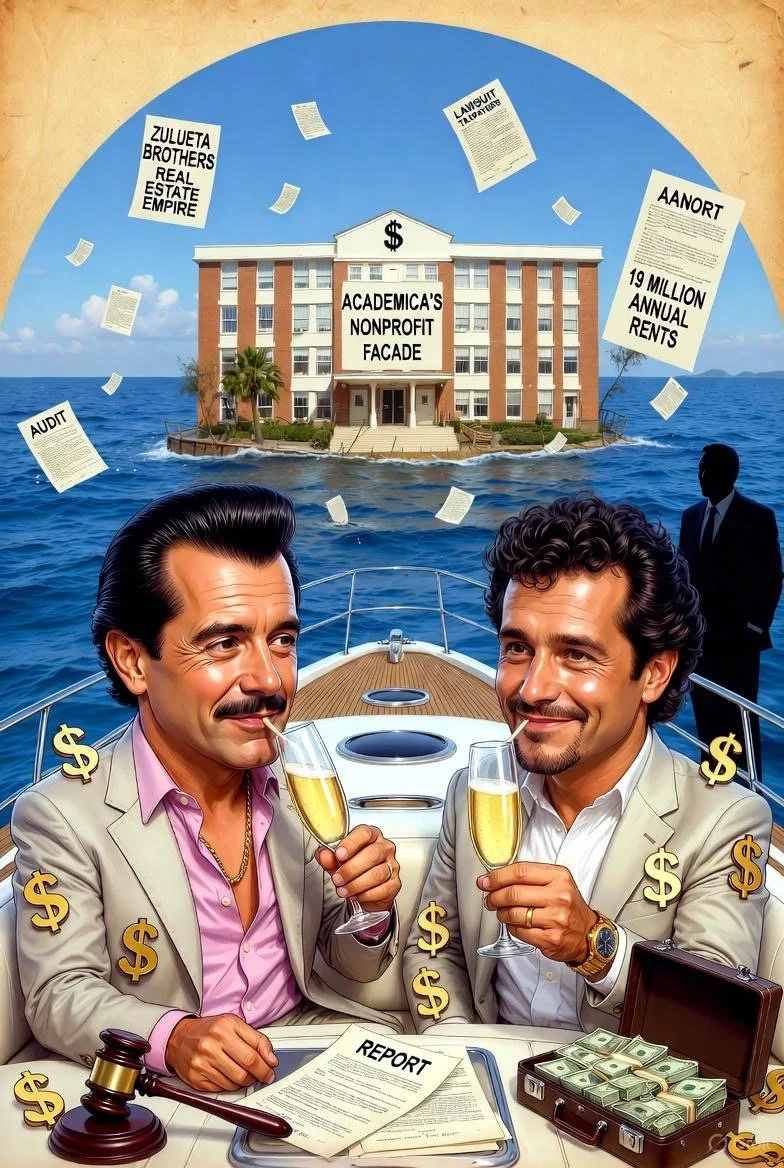
Inside the Predatory Charter Network Targeting Florida’s Most Vulnerable Children
COMPLETE INVESTIGATION
A 27-year empire built on self-dealing, opaque finances, and legislative sleight-of-hand— where taxpayer dollars meant for the neediest kids vanish into real estate deals, management fees, and the pockets of a connected few.
Florida’s public schools aren’t failing by accident. They’re being methodically drowned.
Walk into any classroom across the state and you’ll find a tableau of managed decline: teachers pulling down a median salary of $51,000—literally ranked the lowest in the nation when adjusted for cost of living, a figure that would embarrass a mid-level Applebee’s manager— personally bankrolling supplies that should be budget line items. Crayons. Pencils. Basic dignities.
Meanwhile, the infrastructure crumbles around them. Roofs weep when it rains. Air-conditioning units wheeze like emphysema patients in August. And the support staff—the invisible architecture keeping these schools upright—survive on $33,324 a year, barely $1,174 above the Federal Poverty level. That's $97 a month separating full-time employment from destitution. Poverty wages in a state where rent doesn't care about your noble intentions or your neighborhood's AMI.
The numbers tell a story of deliberate neglect. Per-pupil spending has contracted by $400 since 2019, even after adjusting for inflation’s steady grind—but the true shortfall is far worse. Florida now spends approximately $8,000 less per student than needed to provide an adequate education. This isn’t happening in a state starved for revenue—Florida’s tax coffers have been robust, even flush, with strong economic growth and rising tax revenues. Yet in 2024, the Network for Public Education examined the wreckage and delivered a damning verdict: Florida ranked dead last among all fifty states plus D.C. in adequate school funding. Fifty-first out of fifty-one. The basement below the basement.
Even more damning: Florida’s Effort Index score of 0.48 proves the state invests less than half of what it should relative to its economic capacity. This isn’t about poverty—it’s about choice. States with similar or lower fiscal capacity invest dramatically more in their students. While other states increased education funding post-pandemic, Florida cut or froze spending, moving deliberately against the national trend.
This starvation is policy, not accident. Lawmakers have perfected the art of misdirection, deploying culture-war pyrotechnics to obscure the wholesale abandonment of public education. In 2023, Governor Ron DeSantis signed House Bill 1069 into law, expanding what can only be described as regressive book bans under the sentimental guise of “protecting children”—a phrase that curdles when you consider that over four million Florida children live below the poverty line (47% of all children), and the legislation did precisely nothing to address that crisis.
By systematically limiting access to age-appropriate literature and historical materials—without a public referendum, without consulting actual academic scholars or educators, acting on his own authority alongside Manny Diaz Jr.—the governor and the Florida Department of Education have achieved something perversely impressive: they meet the dictionary definition of indoctrination. Not the contextually vague, undefined political talking point version of "indoctrination" that DeSantis deploys as rhetorical cudgel in his education crusade (HB 7, SB 266, HB 1557, HB 1069).
The actual Merriam-Webster definition of DeSantis’s feared indoctrination, is literally Indoctrination (noun): To imbue with a usually partisan or sectarian opinion, point of view, or principle. Alternate: To instruct, especially in fundamentals or rudiments, while excluding alternative perspectives.
Whether DeSantis recognizes the irony is immaterial. These policies—teaching a single, sanitized perspective while excluding others—foreclose the very critical thinking that education is meant to cultivate. They are indoctrination in its textbook form.
The governor, naturally, staged his photo opportunity signing HB 1557 at an overwhelmingly white, affluent charter school. The location itself was a tell: Classical Preparatory Academy in Spring Hill, Florida—a nonprofit charter established, owned, and operated by Anne Corcoran, wife of Richard Corcoran, DeSantis's first-term Education Commissioner and Diaz Jr.'s predecessor as architect of Florida's privatization machinery.
DeSantis stayed for hours that day, soaking up undeserved applause, his grin brimming with performative pride as if he were truly enacting change meant to "protect our children." , He basked in the theater of it—the cameras, the carefully curated audience, the spectacle of concern—while the majority of students—brown, Black, poor, traumatized—languished in classrooms stripped of books, resources, and the intellectual freedom that actual education requires.
This isn't about protecting children from inappropriate content. It's about controlling what children are permitted to know—and ensuring the architects of privatization profit from the wreckage.
That's not education. That's the manufacture of consensus through enforced ignorance and systemic extraction.
What he didn't mention: 4.2 million Florida children—47% of all children in the state—live at or below the poverty line. That crisis, the one requiring actual protection, went unaddressed. Still does.
This constitutes a direct violation of Florida's Constitution, Article IX, Section 1(a), which mandates: "The education of children is a fundamental value of the people of the State of Florida. It is, therefore, a paramount duty of the state to make adequate provision for the education of all children residing within its borders. Adequate provision shall be made by law for a uniform, efficient, safe, secure, and high quality system of free public schools..."
By consistently underfunding public schools while siphoning federal and taxpayer dollars to what DeSantis euphemistically calls "operators of hope"—the same charter networks documented in this investigation—the state has ensured that the majority of students languish in classrooms that could double as object lessons in institutional abandonment.
The photo op told you everything you needed to know: who matters, who profits, and who gets left behind.
At this writing, 47 percent of Florida’s children live in poverty. The teacher shortage has metastasized past 8,000 vacancies, particularly acute in special education. And then there’s literacy, where the crisis becomes generational. The research is unambiguous: children not reading at grade level by age eight face a dropout risk fifty times higher than their proficient peers, with consequences that compound across a lifetime. In 2025, more than 60 percent of Florida public school students read below grade level. In Sarasota and Manatee Counties, the figure hovers at 54 percent—communities still treading water, still falling behind.
Yet while public schools asphyxiate, public funds flow elsewhere. The state diverted $4 billion in 2023-24 alone to vouchers and charter schools—vouchers now expanded to families earning up to $200,000 annually, with no accountability measures required of the private schools receiving public funds. Charter schools, particularly the so-called Schools of Hope, market themselves as beacons of academic excellence, draped in the respectable garb of nonprofit status. It’s a shell game, an exercise in corporate obfuscation. Peel back the layers of intentionally Byzantine corporate entities—all established, owned, and operated by the same individuals—and the altruistic veneer dissolves.
The architecture of the scheme is elegant in its cynicism. Starve public schools until they buckle. Declare them failures. Redirect funds to politically connected charter operators. Repeat until the public system is a husk, and education becomes one more market where profit, not outcomes, dictates winners and losers.
EXECUTIVE SUMMARY
What We Found:
Florida’s charter school system isn’t broken. It’s working exactly as designed—as a wealth extraction mechanism that transfers billions in taxpayer dollars from public schools to private operators.
This investigation reveals:
- A for-profit management empire built by brothers Fernando and Ignacio Zulueta that controls over $390 million in annual public education funding through a network of 56+ interlocking LLCs and nonprofits
- Management fees exceeding $9 million annually per school—rates reaching 20% of operating budgets, multiples of industry standards—flowing to Zulueta-controlled companies with no competitive bidding
- A $115 million real estate portfolio financed with tax-exempt public bonds, generating approximately $19 million in annual rent, with properties leased back to charter schools at inflated rates determined through sweetheart deals while capital gains flow to private LLCs
- The $400,000 “loan” scandal at Doral College, where federal investigators documented a scheme to funnel taxpayer money between entities controlled by the same people—a loan that was never repaid, resulting in a college that lost accreditation and issued “virtually worthless” degrees
- Florida’s Education Commissioner Manny Diaz Jr., a former Chief Operating Officer earning
$122,000 annually from the Zulueta network’s Doral College, who now oversees the regulatory system that enables their expansion—despite allegations of inappropriate conduct as a teacher (documented by the Miami Herald from multiple former students) and his direct role in the Doral College scandal
- Senate Bill 2510, a 2025 law that forces public schools to hand over facilities, transportation, and services to charter operators rent-free, with only 20 days to prove “material
impracticability”—a nearly impossible evidentiary standard
- Three Sarasota schools targeted for takeover—not because they’re failing, but because they serve predominantly low-income, minority, and disabled students with the least political power to resist
- Suspension rates of 30-40% at some Academica schools—documented multiples of nearby public schools—used as a selection mechanism to exclude challenging students and artificially inflate test scores
- Over 500 charter schools closed in Florida since 2010—an average of 20 per year—many amid financial scandals, leaving students stranded mid-year while operators like Academica continue receiving public funds and approval for expansion despite audit findings
- Federal investigations by the U.S. Department of Education and Inspector General documenting conflicts of interest, self-dealing, and questionable financial practices—yet no meaningful penalties, criminal charges, or restrictions preventing Academica from continuing as a charter operator
What’s At Stake:
Oak Park School—Sarasota County’s only school dedicated to children with profound disabilities—faces co-location by Mater Academy, a charter network managed by the Zulueta empire. The “underutilized” spaces they’re targeting? Hydrotherapy pools. Sensory integration rooms. Medical treatment areas. Equipment storage for devices that keep children alive.
Two other schools—Emma E. Booker Elementary (94% economically disadvantaged, 87% students of color) and Brookside Middle (65% economically disadvantaged, 56% students of color)—both earning A and B grades, both improving academically—face the same forced takeover.
This is not about helping children. This is about profit. And it’s spreading.
In October 2025, over 100 public schools statewide received co-location notices—eight schools in Polk County alone. Orange County and Hillsborough County are bracing for similar raids.
What follows is the complete documentation of how this system works, who profits, and why Florida has become ground zero for the privatization of public education.
I. THE LEVER: How Florida Law Was Rewritten to Enable Takeovers
The weapon that made Sarasota’s crisis possible didn’t exist two years ago.
In spring 2025, the Florida Legislature passed Senate Bill 2510—a sprawling 387-page omnibus bill that gutted safeguards and handed charter operators a statutory sledgehammer to force their way into public school buildings.
The original “Schools of Hope” program, established in 2017, was marketed as targeted intervention: charter operators with proven track records would open near persistently low- performing schools (defined as D or F grades for three consecutive years) in distressed communities. Financial incentives included per-pupil supplements, planning grants, facilities access.
SB 2510 kept the name. It gutted the safeguards. It weaponized the program.
What Changed:
Broadened eligibility: The definition of “targeted schools” expanded beyond persistently failing institutions. Some schools flagged under the new criteria have performance data dating to 2013—more than a decade old. Current grades and recent improvements? Ignored. The law now allows takeover of any school deemed “underutilized,” regardless of academic performance.
Mandatory co-location with extensive support requirements: Charter operators designated as Schools of Hope now have explicit statutory right to occupy “underutilized” public facilities. Districts must provide not just space but transportation, food service, custodial support, maintenance, technology infrastructure—subsidizing charter operations rent-free with “equitable access” to all services.
20-day response window: School districts get 20 days to prove “material impracticability”—an evidentiary burden requiring documentation that charter presence would cause immediate physical danger or render the building structurally unsound. Not fiscal harm. Not educational disruption. Not impact on specialized programs serving vulnerable populations. Physical danger. If districts fail to comply, they face financial penalties and loss of administrative fees.
No local control: No referendum. No meaningful community input beyond notice-and- comment. No real avenue for appeal. State law preempts virtually all district authority—local school boards cannot impose additional requirements, delays, or restrictions.
Priority access with no alternatives required: Charters have statutory priority for available space. Districts may suggest alternatives, but charters are not required to accept them.
Rebecca Beltran, former general counsel for a Florida school district: “This isn’t collaboration. This is a legal hammer disguised as policy. It turns what should be negotiation into mandate, transforming co-location from partnership into forced occupation.”
The Financial Trap:
When a charter co-locates, per-pupil funding follows students who transfer. But the district retains all fixed costs—building maintenance, utilities, insurance, infrastructure.
The math is devastating: A school losing 50 students might lose $250,000 in revenue while still heating the same building, maintaining the same roof, staffing the same front office. Specialized programs—speech therapy, counseling, adaptive equipment—rely on economies of scale. As enrollment declines, programs die.
For schools serving high-needs populations, the damage compounds catastrophically. A school with 300 students might afford a full-time speech therapist; a school with 200 students cannot. Class sizes increase. Support services are cut. The school enters what researchers call a “death spiral”: declining enrollment leads to reduced services, which leads to more families leaving, which leads to further cuts—exactly the outcome needed to justify eventual closure or full charter takeover.
Meanwhile, the charter gets a rent-free facility, subsidized services, and the ability to market
itself as a “new option” while selectively enrolling the least costly students.
Tom Edwards, Sarasota County School Board member: “Everything is on Sarasota’s dime and they come in rent free. I want to rally all of Sarasota and say Tallahassee is out of line. We need to get the entire school district fired up.”
Holly Bullard, Florida Policy Institute: “There is no reason for charter operators outside our community to come here except to take advantage of our tax base and taxpayers. No one asked the parents of these schools if they would want a squatter school to set up shop in their school.”
“Squatter school.” That’s what this is.
II. THE TARGETS: Vulnerability Is the Point
Let’s be crystal clear: Mater Academy didn’t target failing schools. It targeted vulnerable ones.
On October 8, 2025, three Sarasota schools received co-location notices from Mater Academy. Not one was academically failing. Not one showed persistent decline. All three serve predominantly low-income, minority, and disabled students—communities with the least political clout and fewest resources to fight back.
Emma E. Booker Elementary
Demographics:
- 94% economically disadvantaged
- 87% students of color
- 435 students
Performance:
- Recent school grade: B
- Math and reading gains exceeding state projections
- Improved from D to B through sheer force of will Reality:
Named for a pioneering Black educator who taught in Sarasota’s segregated schools when the state refused to adequately educate African American children. Teachers arrive before dawn, stay past dusk, running food pantries and clothing closets out of their own classrooms. They
know which kids slept in cars, which ones haven’t eaten since yesterday’s school lunch, which families fled domestic violence in the night.
Marcus Johnson, fourth-grade teacher: “People talk about ‘school choice,’ but what choice do my students’ families have? Most of them don’t have cars. They can’t transport their kids across town to a charter school. And even if they could, the charter schools don’t want their kids—they don’t want the kid who’s homeless, the kid with a behavioral disorder, the kid who’s two years behind in reading.”
This school is succeeding against impossible odds. That, the investigation reveals, is precisely why it was targeted.
Brookside Middle School
Demographics:
- 65% economically disadvantaged
- 56% students of color
- Built 1955—a community cornerstone for 70 years
Performance:
- Steady A and B grades year after year
- No persistent academic decline
- No documented crisis
Reality:
Teachers coach basketball in donated shoes. The band director pays for instrument repairs out of pocket. Students carry invisible burdens—financial strain, family trauma, language barriers— while navigating early adolescence, one of the most turbulent developmental stages of human life.
These are 11-14-year-olds whose brains are undergoing profound restructuring that shapes emotional regulation, identity, and social awareness. The relationships and experiences formed in these years leave lasting imprints.
And through it all, Brookside’s teachers stretch themselves to meet every need—academic, emotional, human.
No crisis here—except the one about to be manufactured.
Oak Park School
Demographics:
- 64% economically disadvantaged
- 45% students of color
- 225 students K-12
What Makes It Different:
Oak Park is Sarasota County’s only public school dedicated exclusively to children with profound, complex disabilities. It’s the only option within 60+ miles for families who cannot afford private special education—which costs $18,000+ per year. Combined with medical expenses and insurance, families could spend $234,000 for a full K-12 education.
More than 8,000 students (18% of Sarasota County’s K-12 population) have identified disabilities. Most are placed in mainstream classrooms without adequate staffing, resources, or therapeutic programs. Oak Park stands alone.
The Reality of This School:
Progress here doesn’t show up on standardized tests. It sounds like a child’s first laugh through a speaking valve. It looks like three unassisted steps after two years of daily physical therapy. It feels like a mother weeping with joy because her son with a traumatic brain injury finally recognized her face.
Wide hallways engineered for wheelchairs and walkers. Communication devices costing more than cars. Sensory rooms bathed in calming blues, stocked with tens of thousands of dollars in adaptive equipment. Staff-to-student ratio near 1:3 because some children need a grown adult’s steady grip just to swallow lunch without choking.
The “Underutilized” Spaces Mater Academy Covets:
- Hydrotherapy pool where children with spina bifida build strength without gravity crushing their spines
- Sensory integration rooms where children with severe autism learn to tolerate clothing textures
- Medical treatment areas where nurses suction tracheostomy tubes and monitor feeding pumps
- Equipment storage for Hoyer lifts, adapted bicycles, communication devices—the unglamorous apparatus that makes life possible
These rooms aren’t empty. They’re lifelines.
Elena Ramirez, speech therapist at Oak Park for 12 years: “We make it work because we love these kids and we are committed to them. But it is heartbreaking to know what we could do for them if we had the resources. And now we are being told we might have to share our building, share our already-inadequate resources, with a charter operator who will skim money off the
top
to pay their management company and their landlords.”
Jennifer Ortiz, mother of Sofia (11, cerebral palsy): “If they do this, they are not just taking space. They are taking my daughter’s future. Sofia needs a nurse. She needs a physical therapist. She needs a classroom with a lift to get her in and out of her wheelchair. If the school has to share those resources, or if they lose funding because kids leave, what happens to her? Where does she go?”
Maria Torres, special education advocate: “Targeting
schools that serve predominantly Black,
brown, and disabled children isn’t a bug in this system.
It’s the feature. It’s the entire point.”
III. THE ARCHITECTS: A 27-Year Empire Built on Public Money
To understand who’s behind this expansion requires tracing a web of corporate entities, real estate holdings, and political connections spanning more than two decades—a network that’s been the subject of federal audits, investigative journalism, and persistent questions about whether the line between public mission and private profit has been erased entirely.
At the center: brothers Fernando and Ignacio Zulueta.
The Corporate Structure: A Russian Nesting Doll of Self-Dealing
The Innermost Doll: Nonprofit Collection Vehicles
Public-facing entities like Mater Academy, Inc., Mater Academy Central, and Mater Foundation collect $390 million annually in taxpayer funds— state FEFP allocations, federal Title I grants, local
property tax levies.
Same interlocking board of directors. Same administrative offices. No real independence.
These nonprofits exist primarily as collection vehicles, funneling public dollars into the next layer.
The Middle Doll: For-Profit Management
Academica Corporation, owned and controlled by the Zulueta brothers, “manages” virtually everything for the charter schools—curriculum, hiring, facilities, vendor contracts—in exchange for management fees of 10-15% of operating budgets.
These percentages dwarf industry standards. Between 2011 and 2014, some schools paid management fees exceeding 20 percent of their revenue to Zulueta-controlled entities—over $9
million annually for a single school—with no competitive bidding process.
But it gets worse.
Properties housing these publicly funded schools? Often leased from separate Zulueta- controlled LLCs at above-market rates determined through sweetheart deals with no competitive bidding. By 2010, at least 9 schools were paying rents exceeding 20 percent of their revenue to related parties.
The brothers negotiate with themselves, set their own prices, and invoice their own schools.
The Outermost Doll: Real Estate Empire
By 2010, the Zulueta brothers controlled an estimated $115 million in tax-exempt Florida real estate, generating approximately $19 million in annual rent flowing from public schools to Zulueta-controlled entities.
The scheme is elegantly simple:
1. Buildings are purchased using tax-exempt public bonds issued on behalf of charter schools
1. Those same buildings are leased back to the publicly funded schools at inflated rates
1. When properties appreciate or are sold, capital gains flow to private LLCs
Public financing. Private profit.
Jordan Mitchell, forensic accountant who has analyzed charter financial structures for two
decades: “This is self-dealing at an almost incomprehensible scale. They negotiate with themselves, set their own prices, and siphon public funds with absolute impunity. The oversight mechanisms that are supposed to prevent this simply don’t function.”
The Smoking Gun: Doral College
The Doral College scandal remains the clearest proof of the system’s corruption.
In 2011, Doral Academy Preparatory—a publicly funded charter school—extended a $400,000 “loan” to Doral College, a Zulueta-controlled for-profit institution where Manny Diaz Jr. served as Chief Operating Officer.
The loan was never repaid.
The fake dual-enrollment arrangement allowed Doral College to siphon additional state funds by claiming students were simultaneously enrolled—students from Academica charter schools taught by their own charter high school teachers, using public funding, earning credits that could not transfer to any accredited institution. Only students from Academica-run schools could enroll, creating a closed financial loop where public dollars flowed from charter schools to the affiliated for-profit college.
When federal investigators finally circled, the college lost its accreditation in 2017. Education experts described the degrees Doral College issued as “virtually worthless.”
No one went to jail. No one was barred from receiving public funds. The empire simply reorganized and continued expanding.
Federal Investigations: Documented Misconduct Without Consequences
The U.S. Department of Education and its Inspector General audited Academica and its affiliated Mater Academy network, focusing on allegations of conflicts of interest, public funds transferred to private foundations, and self-dealing through real estate and management contracts.
Auditors identified:
- Multiple related-party transactions where public funds flowed to entities controlled by
Academica’s founders
- Leases between Mater Academy and Academica-affiliated development companies with no competitive oversight
- Public money transferred to Mater’s nonprofit foundation without proper documentation
- Missing records for expenditures
- Contracts with related parties executed without proper board approval
Despite these findings: No meaningful civil penalties. No criminal charges. No restrictions levied by state or federal regulators. Academica was not barred from continuing as a charter operator.
Why Academica Remains Eligible Despite Documented Violations
Intentionally weak oversight structure: Florida’s charter law requires operators be only “clear of financial emergency conditions” for eligibility. Academica’s audits have not officially triggered this threshold despite multiple flags, because the opaque finances and absence of direct competitive bidding make it difficult to prove violations that meet the narrow legal standard.
Legislators with direct ties to Academica’s business network have consistently rewritten laws to relax district authority and accountability provisions, making it extremely difficult for regulators, school districts, or parents to block Academica’s expansion.
The 2025 “Schools of Hope” law (SB 2510) broadened eligibility for charter operators, allowing them to take over public school facilities regardless of past audit findings or ongoing investigations.
High test scores used to justify continued operation: The Florida Department of Education regards previous audit findings as “appearance of conflict” rather than proof of actionable fraud, and considers academic performance in evaluations—enabling companies like Academica to argue their results justify continued candidacy, even when those results are achieved through student selection rather than educational excellence.
Even with over 500 charter schools having closed in Florida since 2010—including some managed by Academica—none of these closures resulted in Academica itself being barred from the industry. The company simply reorganizes, opens new schools, and continues receiving public funds.
The Pattern of Misconduct
Since 2010, over 500 charter schools in Florida have closed, many amid scandals involving financial mismanagement, fraud, or abrupt abandonment of students mid-year.
The Academica network itself has been repeatedly flagged:
Financial Violations:
- 2011 Miami Herald investigation: Zulueta brothers amassed real estate portfolio of $115+ million in Florida properties used by charter schools, much financed through tax-exempt bonds
- 2014 NPR audit: Some Academica-managed schools paying 20%+ of budgets in management fees and rent to related parties—no competitive bidding
- Multiple audits flagging commingling of funds, missing documentation for expenditures, contracts with related parties without proper board approval
Safety Failures:
- 2018: Somerset Academy coach arrested for sexual misconduct with a student; school failed to conduct proper background checks; complaints about the coach ignored by administrators for months
- 2021: Academica-affiliated Miami school faced allegations that faculty member engaged in inappropriate conduct with multiple students; parents reported administrators were dismissive, prioritized protecting school’s reputation over investigating
- Recent/2025: One Doral faculty member found guilty of multiple counts of sexual misconduct with minors; maintenance manager at Mater Academy Biscayne arrested on child abuse charge after making sexually inappropriate comments to 15-year-old student in school cafeteria
Statewide Charter Closures: An Integrity Florida report documented that charter school closures cause problems for school districts that must absorb students, resulting in taxpayer losses on lease payments and school improvements. In one documented case, Marcus May, owner of the Newpoint Charter School chain, was convicted in 2018 of racketeering and fraud across six different school districts, pocketing millions of dollars. He was ordered to pay $5.5 million in fines and restitution (ballooned to $7 million with interest). As of recent court proceedings, he had paid only $270,000 while claiming he cannot afford remaining payments.
The pattern is consistent enough to constitute a business model: extract public dollars, deliver private failures, move on when scandals break.
IV. THE FIXER: Manny Diaz Jr. and the Captured State
Manny Diaz Jr. is not a public servant. He’s a fixer for the charter industry, now sitting in the commissioner’s chair with the power to approve the very takeovers that enrich his former employers.
The Teaching Years: Normalizing Inappropriate Conduct
In the 1990s, while teaching social studies at Hialeah-Miami Lakes Senior High, multiple students accused Diaz of inappropriate conduct. They described comments about female students’ appearances, casual discussions of drugs and clubbing, and flirtatious behavior that blurred professional lines.
Alumni corroborated these claims. The Miami Herald documented the accounts in January 2021.
From former students:
Jenny Lee Molina, class of 1999, tweeted that Diaz was a “pervert” and “inappropriate teacher” who openly discussed ecstasy use at Miami clubs like “Space” with students. In a subsequent radio interview, Molina stated: “Diaz, it’s concerning that myself and other high school students you taught still think you’re a pervert and inappropriate teacher who talked about ‘rolling at Space’ openly. You were 28. I was 17. Still remember you trying to be the ‘cool’ teacher who was a little too friendly.”
Another former student recalled: “He was always flirting with the girls and trying to be the popular teacher. Everything she said about him is true, all the partying.”
Neyda Borges, 1999 graduate: “He was one of the younger ‘cool’ teachers” in a culture of
“really weird behavior,” joking with male students about club culture while making suggestive
comments about girls’ clothing and conduct—normalizing inappropriate behavior.
Importantly, former state Representative Cindy Polo (a Democrat) tweeted in January 2021: “Heard this from a few former students and now constituents. They didn’t speak up bc he later became Principal, I believe.”—suggesting the allegations had circulated within education circles well before becoming public.
Diaz’s Response: He denied the allegations and characterized them as “baseless and
defamatory” political attacks. His attorney cited a text message Molina sent in 2013 thanking him as a teacher. However, Molina responded that she had never claimed to be a victim and that none of Diaz’s conduct was illegal, explaining that the inappropriate comments did not constitute criminal activity even if they were unprofessional.
Result: No investigation was conducted. No disciplinary action was taken. These allegations didn't derail his career. He came from a politically connected family. Doors stayed open.
What would have ended most careers—allegations carrying unmistakable Epstein-esque undertones, corroborated by multiple former students, alumni, and a sitting State House Representative—became a non-issue. Inconvenient noise, easily dismissed.
And then, in a move that defies any coherent definition of "protecting our children"—the very crusade DeSantis claimed as his North Star—the governor appointed Diaz Jr. as Florida's Education Commissioner. Not months later, not years later. Six months after the Miami Herald documented the allegations in January 2021, DeSantis announced Diaz's appointment in June 2022.
The man accused of inappropriate conduct with minors would now oversee the education system for 2.9 million Florida students.
The Selective Enforcement of "Protecting Children"
Consider the grotesque asymmetry: While lawmakers felt it necessary to ban thousands of age- appropriate books on puberty or even children's stories featuring two gender-neutral penguins— narratives somehow interpreted as attempts to indoctrinate children or influence their sexual orientation or gender identity—the state simultaneously elevated a man facing multiple, corroborated allegations of inappropriate conduct with students to its highest education post.
The convergence of House Bill 1069 and House Bill 1285 created a surveillance apparatus where any resident—parent or not, credentialed or not—can file formal objections challenging any book in a K-12 public school library or classroom. The result: classics like The Great Gatsby by F.
Scott Fitzgerald, The Diary of a Young Girl by Anne Frank, and Anna Karenina by Leo Tolstoy banned from Florida schools and libraries.
In total, 3,150+ books were banned in Florida from 2020 through 2022.
HB 1557, the so-called Parental Rights in Education Act, further prohibits classroom discussion about sexual orientation or gender identity, restricts the use of pronouns, expands book-banning procedures, and censors reproductive health curriculum.
The state moved heaven and earth to "protect" children from penguins and pronouns.
But multiple allegations against Diaz Jr., raised by unrelated parties, supported by former alumni and a State House Representative? No investigation. No scrutiny beyond Diaz's blanket denial characterizing them as baseless, defamatory "political attacks." The matter was closed before it was ever opened.
The irony wasn't lost on critics. But irony doesn't stop appointments. Political loyalty does the work that qualifications and ethics cannot.
The Academica Years: Profiting from the Grift
From 2009 to 2013, Diaz served as Chief Operating Officer of Doral College—the Zulueta
brothers’ for-profit diploma mill.
During his tenure, Doral College accepted the $400,000 loan from Doral Academy Preparatory—a publicly funded charter school managed by Academica. Federal investigators determined the arrangement was designed to funnel public money between entities controlled by the same people.
The dual-enrollment scheme involved enrolling high school students from Academica charter schools in “dual enrollment” college courses at Doral College—taught by their own charter high school teachers using public funding, with credits that could not transfer to any accredited institution.
The loan was never repaid. Doral College lost accreditation in 2017. Students were left with worthless degrees.
Diaz reportedly earned $122,000 annually during his 12-13 years on Doral College’s board.
By the time the scandal broke, Diaz had moved on—first to legislative roles, then to statewide office.
The Legislative Years: Gutting Oversight
As a state legislator, Diaz repeatedly sponsored bills expanding charter access, reducing district oversight, and loosening financial reporting requirements.
Most egregiously, in 2017, while serving as House PreK-12 Appropriations Subcommittee chairman, Diaz sponsored a budget provision allowing Jefferson County schools—which were transitioning to all-charter control through Somerset Academy (operated by Academica)—to use construction funding to pay severance for teachers being fired. This provision was championed by Doug Rodriguez, the Doral College president (Diaz’s boss), who also served as consultant leading the charter transition in Jefferson County.
Ethics watchdogs flagged the arrangement as a clear conflict of interest. Patricia Brigham, executive director of the League of Women Voters, stated: “Manny Diaz is receiving money from the charters. He’s getting a six-figure salary. And he’s the current Senate Education Chair. I don’t understand how that is not a conflict of interest.”
Diaz sponsored the original draft of House Bill 7069—the “Schools of Hope” law enabling charter school takeovers—and introduced the final version that included the takeover provisions, while simultaneously receiving a six-figure salary from Academica’s Doral College.
Public records show campaign contributions flowing from charter-affiliated entities. Charter Schools USA regularly made maximum $1,000 contributions to Diaz and contributed $25,000 to his political committee—exactly one month after DeSantis appointed him Education Commissioner.
The Commissioner: The Fox Guarding the Henhouse
In 2022, Governor Ron DeSantis appointed Diaz Florida’s Education Commissioner—granting him authority over the very programs and facilities that once lined his pockets.
DeSantis praised Diaz’s alignment with his education agenda, specifically citing his sponsorship of legislation eliminating standardized testing and the “Stop Woke” law restricting race-related instruction. DeSantis stated: “Manny Diaz has done a great job in the Legislature on education issues ranging from teacher pay to parental rights and choice. I am confident that he will serve our state well as the Commissioner of Education.”
He now:
- Approves charter applications
- Greenlights co-locations
- Oversees billions in education funding
- Administers the Schools of Hope program that enabled the Zulueta network’s Sarasota raids
- Interprets and enforces financial regulations governing operators like Academica
This is the same regulatory authority that should be scrutinizing the very financial arrangements—the $400,000 loan, the management fees, the real estate deals—that benefited Diaz and involved entities that still pay his former colleagues.
In 2025, DeSantis gave Diaz a second six-figure job as interim president of the University of West Florida—effectively providing dual compensation from the education system he oversees. Critics characterized the appointment as DeSantis installing a political operative to advance a
conservative agenda. While serving as Education Commissioner, Diaz had actively led statewide efforts to eliminate diversity, equity, and inclusion programs from public institutions—the same mission now guiding his work at UWF.
Alicia Summers, former federal prosecutor and government ethics professor: “You have the state’s top education official, the referee, who used to work for one of the players. Even if he recuses himself, the structure itself undermines public trust.”
Diaz’s office declined comment. The Department of Education insists he “has no financial interest in any charter operator” and that decisions are guided by law and student outcomes.
Right. And the cat had no interest in the cream.
When Sarasota parents rallied against the Oak Park co- location, Diaz’s response was measured and clinical: co-
location “expands opportunity” and “increases parental choice.”
Parents heard something else entirely: hostage-taking dressed as reform.
Academica’s Official Response
Academica’s website now features a banner message attempting to reframe the takeovers:
“A recent state statute and rule change allows charter schools to co-locate at underused public schools facilities. This positive development can assist Florida School Districts in making better use of empty classrooms and revitalize under-enrolled schools… This is not about replacing or displacing existing schools. It is about working together to expand public access to underutilized school facilities and creating new educational opportunities for families.”
The message admits they “sent hundreds of letters because hundreds of the districts’ facilities are under-enrolled” but claims they’ll only open “a handful of schools for the 2027-28 school year” and will “rescind notices for locations that will not be used.”
This PR offensive doesn’t address the fundamental question: Why are schools serving the state’s most vulnerable students—children with profound disabilities, children living in poverty, children of color—being targeted as “underutilized” when their specialized programs require exactly the space and resources Academica covets?
V. THE PERFORMANCE PARADOX: How Charter “Success” Is Built on Exclusion Academica loves to wave test scores and school grades like they’re proof of educational
excellence. They’re not. They’re proof of selection.
When charter operators market their schools, the pitch is seductive: high performance, rigorous standards, results that speak for themselves. Many Mater Academy schools boast A or B grades from the state, impressive test scores, long waiting lists.
But a closer examination reveals a system that succeeds by selecting students rather than serving them.
The Hyper-Segregation Premium
A 2019 analysis by education researchers at UCLA found that charter schools operated by large for-profit management companies were among the most racially and economically isolated schools in their regions—schools where 90-95% of students were Black or Hispanic and economically disadvantaged.
Traditional public schools in the same communities often had more diverse student bodies because they were required to serve all comers, including white and middle-class families who lived in the attendance zone.
This hyper-segregation is marketed as “serving underserved communities.” It’s actually creating isolated schools where the most vulnerable students are concentrated, cut off from the resources that come with economic and racial diversity.
The Discipline-to-Dismissal Pipeline
One of the most effective selection mechanisms: aggressive use of disciplinary exclusion.
Multiple investigations and parent complaints have documented that certain Academica- affiliated schools maintain disciplinary policies resulting in extraordinarily high rates of suspension—particularly for Black and disabled students.
In some schools, suspension rates have exceeded 30-40% of enrollment in a single year—rates that are multiples of those at nearby traditional public schools.
National research on charter school discipline confirms this pattern is widespread: In 2011-12, 374 charter schools suspended 25% of their enrolled student body at least once. Nearly half of all Black secondary charter school students attended one of 270 charter schools that were hyper- segregated (80% Black) with aggregate Black suspension rates of 25%. 235 charter schools suspended more than 50% of their enrolled students with disabilities.
How it works:
Students who are suspended are sent home with packets of work to complete independently. Technically, they remain enrolled. Practically, they’re removed from the classroom, excluded from instruction.
If suspensions are frequent or lengthy enough, students are pushed toward dropout or transfer.
The academic effect is twofold:
1. Students who are most struggling—those with behavioral challenges, those who lack support at home, those navigating trauma or disability—are removed from the testing pool, either because they’re literally absent on test days or because they’ve left the school entirely
1. Students who remain are, by definition, those who are most compliant, most likely to have stable home environments, most likely to succeed on standardized tests
Dr. Raymond Carter, sociologist at University of Florida who has studied charter school suspension practices: “It’s a selection mechanism disguised as discipline. You create a behavioral code that is extremely strict, you enforce it aggressively, and you disproportionately target students who are already marginalized. The students who can’t or won’t comply leave. And then you test the students who are left and claim success.”
Documented example:
In 2018, a group of parents at a Mater middle school in Hialeah filed a complaint alleging the school had suspended more than 40 students—nearly all of them Black or Hispanic boys—in a single month, many for minor infractions like uniform violations or talking back to teachers.
When academic outcomes for those excluded students were examined, the pattern was unmistakable: nearly all had been performing below grade level before suspensions. After being removed from school for days or weeks, most fell further behind. Several eventually transferred to traditional public schools or dropped out.
Meanwhile, the school’s aggregate test scores—calculated only for students who remained enrolled and present on test day—rose.
The Creaming Effect: “Choice” as Selection
Even absent overt disciplinary exclusion, charter schools shape their student populations through practices that function as barriers to entry:
- Application processes requiring in-person meetings
- Behavioral contracts parents must sign
- Strict attendance policies that penalize families for medical or transportation challenges
- Fees for uniforms or activities
- Volunteer hour requirements
All of these deter or exclude families who are housing-insecure, who work multiple jobs, who are navigating crises.
Traditional public schools, by contrast, must enroll any student who lives in the attendance zone, regardless of behavior, academic history, or parental capacity to comply with administrative requirements. They cannot counsel out struggling students. They cannot impose behavioral contracts as a condition of enrollment.
They must serve everyone.
When test scores are compared between the charter and the traditional school, the charter often looks better. But the comparison is fundamentally flawed, because the two schools are not serving the same population.
Dr. Michelle Strater, education economist: “You cannot claim that your model is superior if your model depends on not serving the hardest-to-serve students. That’s not innovation. That’s fraud.”
Akil Bello, nationally recognized testing and accountability expert: “Your model only looks successful if mine is forced to take every child you reject. That’s not competition. It’s a rigged game.”
VI. THE CONTEXT: Florida’s Manufactured Crisis
To understand why Florida has become ground zero for charter takeovers requires understanding the deliberate starvation of public education that preceded it.
Florida’s public schools aren’t struggling by accident. They’re struggling by design.
Dead Last: The Systematic Defunding
In March 2024, the Network for Public Education released a comprehensive analysis of school funding across all fifty states and D.C.
Florida’s ranking: dead last—51 out of 51—in its capacity and effort to adequately fund public education.
The numbers:
- 50th in the nation for average teacher pay (two consecutive years) at roughly $51,000— thousands below national average when adjusted for cost of living, barely enough to afford housing in many urban centers
- Education support professionals earn an average of $33,324 per year—well below Florida’s
own living wage benchmark
- Per-pupil spending declined $400 since 2019 (inflation-adjusted) even as costs for textbooks, utilities, everything rose sharply
- But the true shortfall is approximately $8,000 per student less than needed to provide adequate education
- Teacher vacancies surpassed 8,000 in 2024, particularly acute in special education
- Effort Index score of 0.48—proving Florida invests less than half of what it should relative to its economic capacity
This is not austerity driven by lack of resources. Florida’s economy has grown substantially. Tax revenues have increased. The state maintains healthy reserves.
The defunding of public education is a choice—a political choice made repeatedly by a legislature and governor who have decided that traditional public schools are not a priority.
States with similar or lower fiscal capacity invest dramatically more in their students. While other states increased education funding post-pandemic, Florida cut or froze spending, moving deliberately against the national trend.
The Politics of Manufactured Crisis
In 2023, Governor Ron DeSantis signed House Bill 1069, marketed under the banner of
“parental rights” and “protecting children.” The bill imposed curriculum restrictions, expanded book-banning provisions, created mechanisms for parents to challenge instructional materials.
DeSantis described the bill as essential to “keeping our children safe” from inappropriate content and ideological indoctrination.
What he didn’t mention:
- 47% of Florida children live in households below the poverty threshold—among the worst rates in the nation
- Over 60% of Florida public school students are not reading at grade level—a literacy crisis with profound implications for everything else
- Children who can’t read at grade level by age 8 face dropout risk fifty times higher than proficient peers, with consequences that compound across a lifetime
The juxtaposition is obscene: Florida’s children are hungry, housing-insecure, and falling behind academically—and the state’s response is to ban books, restrict curriculum, and divert resources from schools serving those children to private operators.
Dr. Noreen Alvarez, former state education official: “This is not about improving schools. This
is about destroying public education and profiting from the wreckage.”
The Two-Tier System: Public Scarcity, Private Plenty
The starvation of traditional public schools stands in stark contrast to the generosity extended to charter schools and voucher programs.
Florida now spends over $4 billion annually on vouchers and tax credit scholarships allowing families to send children to private schools—many religious institutions not required to meet the same academic standards, teacher certification requirements, or accountability measures as public schools.
Vouchers have been expanded to families earning up to $200,000 annually—meaning public dollars subsidize private school tuition for upper-middle-class and wealthy families, with no meaningful accountability for how that money is spent or whether students learn.
Charter schools have access to capital funding streams, startup grants, and facilities assistance programs that traditional public schools can only dream of.
The Schools of Hope program itself comes with substantial per-pupil funding supplements— money that flows to charter operators but not to traditional public schools serving similar populations in the same neighborhoods. High-poverty districts often receive less funding than affluent districts, creating a systematic two-tiered system where resources flow away from need.
The message is clear: the state’s priority is not educating all children well. It’s creating a parallel system where public dollars are funneled to private operators, and public institutions serving the most vulnerable are left to wither.
Marianne Foster, veteran teacher at Title I elementary school in Tampa: “We are being asked to do more with less every single year, while charter operators are given startup funds and facility assistance and per-pupil supplements. And then when our test scores drop because we have bigger classes and fewer resources, they say it’s because we’re failing. It’s gaslighting on a statewide scale.”
Marcus Johnson, fourth-grade teacher at Emma E. Booker Elementary: “People talk about ‘school choice,’ but what choice do my students’ families have? Most of them don’t have cars. They can’t transport their kids across town to a charter school. And even if they could, the charter schools don’t want their kids—they don’t want the kid who’s homeless, the kid who has a behavioral disorder, the kid who’s two years behind in reading. They want the kids who are easy to teach. So we get all the kids with the highest needs and a fraction of the resources. And then we’re called failures when we can’t work miracles.”
VII. THE TRAP: How Co-Location Becomes a Death Spiral
To understand what’s at stake in Sarasota, it’s necessary to understand what happens when a charter school co-locates in a traditional public school.
The Legal Requirements
Under SB 2510, districts must provide:
- Space proportional to charter enrollment
- Access to shared spaces: cafeterias, gyms, libraries, playgrounds
- “Equitable access” to services: transportation, food service, custodial/maintenance support, technology infrastructure
In practice: If a student lives in the district’s attendance zone and chooses to attend the charter school operating in the district building, the district must bus that child, feed that child, and maintain the classroom that child occupies—even though the per-pupil funding for that child now flows to the charter.
The Financial Mathematics
Fixed costs don’t decline proportionally when enrollment drops. A school that loses 50 students may lose $250,000 in revenue, but it still has to heat the same building, maintain the same roof, staff the same front office.
For schools serving high-needs populations, the damage compounds. Specialized programs— speech therapy, occupational therapy, counseling services—rely on economies of scale. A school with 300 students might afford a full-time speech therapist. A school with 200 students cannot.
As enrollment declines, programs are cut, class sizes increase, and the school enters what education researchers call a “death spiral”: declining enrollment leads to reduced services, which leads to more families leaving, which leads to further cuts.
Meanwhile, the charter operator benefits from a rent-free facility, subsidized services, and the ability to market itself as a new option. If the charter is selective in enrollment—counseling out students with behavioral issues, lacking capacity to serve students with severe disabilities, requiring parents to provide transportation or volunteer hours—it can cream off the least costly students, leaving the traditional public school with higher concentration of need and fewer resources to meet it.
Dr. Linda Hernandez, former principal in Miami-Dade who fought co-location in 2019: “This is not a partnership. It is a hostile takeover dressed up in the language of choice. What happened
to us was, the charter moved in, they took the nicest classrooms, they got access to our cafeteria and our gym, and within two years our enrollment had dropped by 30%. We lost teachers. We lost our art program. We lost our after-school tutoring. And the charter’s enrollment grew. That was the whole point.”
The Sarasota Crisis
In October 2025, Mater Academy’s filings strategically targeted schools operating at 43-58% capacity—a figure that ignored crucial context.
Oak Park’s “empty” rooms aren’t vacant classrooms waiting to be filled. They’re specialized therapy suites, sensory integration spaces, medical treatment areas, equipment storage for devices that keep children alive.
Booker Elementary’s “underutilization” reflected smaller class sizes necessary for students living in profound poverty and trauma.
Brookside’s numbers ignored the reality that middle schoolers need science labs, art rooms, and band practice spaces that sit empty during certain periods.
By November 8, 2025, Sarasota’s school board voted in emergency session to frantically reorganize school assignments and redraw attendance boundaries, artificially hiking capacity numbers in a desperate bid to barricade doors against Mater’s invasion.
They were partially successful—but only through bureaucratic contortions that disrupted educational continuity for thousands of students.
Superintendent Terry Connor in statement to Suncoast Searchlight: “We have significant concerns about the impact these proposals would have on students, staff, and programs currently in place at these schools. These are established district-operated campuses that serve important roles in their communities.”
School Board member Sandra Goodwin: “We are fighting this with everything we have. But we need to be honest with families. The law has changed. We do not have the power we used to have to protect our schools.”
The Statewide Pattern
Too late for some districts. By November 2025, co-location notices had surpassed 100 statewide, concentrated in the Tampa Bay area and South Florida.
In Polk County, eight public schools received notices in October 2025 alone. Orange County and Hillsborough County brace for similar raids, watching Sarasota’s playbook unfold as charter operators sharpen their legal briefs.
VIII. THE PLAYBOOK: A National Template for Privatization
What’s unfolding in Florida isn’t unique. It’s a refined playbook that’s been tested, iterated, and exported to vulnerable districts across America.
The Eight-Step Model:
1. Starve public schools through legislative budget cuts and funding diversions, creating the appearance of failure
1. Label schools as failing using manipulated metrics that ignore poverty, disability, and trauma while rewarding schools that exclude challenging students
1. Rewrite laws through lobbying and campaign contributions, lowering barriers for charter takeovers and co-location mandates (see: SB 2510)
1. Build opaque corporate nests using interlocking nonprofits, for-profit management companies, and real estate LLCs that obscure money flows and accountability
1. Install political protectors in oversight positions—ideally people who previously worked for the charter operators and owe their careers to the network
1. Target vulnerable districts serving poor, minority, and disabled students with the least political power to resist
1. Cream students by selectively enrolling higher-performers and pushing out expensive, challenging cases, then tout superior test scores as proof of excellence
1. Rinse and repeat—Detroit, New Orleans, Los Angeles, Philadelphia, and now Florida. The
lab rat today becomes America’s blueprint tomorrow
Dr. Ethan Cardenas, professor of education policy at Florida State University who has tracked charter expansion for 15 years: “Florida is the canary in the coal mine. What happens here, in terms of charter expansion and the erosion of local control, is a preview of what could happen nationally if these policies spread. And they are spreading.”
IX. THE ACCOUNTABILITY GAP: Two Systems, Two Standards
The fundamental asymmetry in Florida’s education system isn’t about quality. It’s about accountability.
Public Schools: Operating in a Fishbowl
- Budgets published line by line
- Teacher certifications verified
- School board meetings public, recorded, archived
- Elected board members can be voted out
- Principals answer to superintendents who answer to communities
- Every decision subject to sunshine laws, open records requests, public scrutiny
When a traditional public school is designated low-performing, consequences are swift: The school may be placed under state control, principal removed, teachers reassigned.
Charter Schools: Operating in Shadows
- Management contracts proprietary
- Vendor relationships opaque
- Board members hand-picked by management companies, not elected by communities
- Financial statements filed months late, often missing crucial details about related-party transactions
- When scandals break, charters simply close and reopen under new names with the same operators
- Teachers not required to hold state certifications
- Discipline data goes unreported
- Special education students counseled out or never enrolled in the first place
When a charter school fails, consequences for students can be catastrophic—schools closing mid-year, leaving families scrambling. But consequences for operators? Minimal. The management company moves on to the next school, the next community, the next opportunity.
Because the corporate structures are so complex—webs of nonprofits and for-profits, LLCs and subsidiaries—it’s nearly impossible to trace accountability to individuals.
Rebecca Beltran: “We hold traditional public schools to a standard of perfection and charter schools to a standard of ‘did they break any laws that we can prove.’ And even when they do break laws, the enforcement is so weak that there is no real deterrent.”
Jordan Mitchell, forensic accountant: “The charter sector in Florida operates with a level of impunity that would be unthinkable in any other context where public money is involved. You have operators who have been flagged in audits, who have been the subject of investigations, who have schools that have closed amid scandal—and they are still approved to open new schools. The accountability mechanisms that are supposed to exist simply do not function.”
X. THE HUMAN COST: What Defunding and Privatization Look Like in Classrooms
Behind the statistics and policy debates are children—real children, whose educational opportunities and life trajectories are being determined by decisions made in boardrooms and legislative chambers by people who will never meet them.
At Oak Park School
Teachers describe working with donated supplies and aging equipment because the budget for adaptive technology has been frozen for years. Therapy sessions are shorter and less frequent than they should be because there’s not enough staff. Classrooms that should have one-on-one aides for students with profound needs instead have one aide for every three or four students.
Elena Ramirez, speech therapist at Oak Park for 12 years: “We make it work because we love these kids and we are committed to them. But it is heartbreaking to know what we could do for them if we had the resources. And now we are being told we might have to share our building, share our already-inadequate resources, with a charter operator who will skim money off the top to pay their management company and their landlords.”
At Emma E. Booker Elementary
The library is staffed only two days a week because the district cannot afford a full-time librarian. The art and music programs that once defined the school’s culture have been cut back
to once a week. Class sizes have crept up from 18 students to 24, then to 28. Teachers buy crayons and notebooks with their own money.
Marcus Johnson, fourth-grade teacher: “People talk about ‘school choice,’ but what choice do my students’ families have? Most of them don’t have cars. They can’t transport their kids across town to a charter school. And even if they could, the charter schools don’t want their kids—they don’t want the kid who’s homeless, the kid who has a behavioral disorder, the kid who’s two years behind in reading. They want the kids who are easy to teach. So we get all the kids with the highest needs and a fraction of the resources. And then we’re called failures when we can’t work miracles.”
At Brookside Middle School
Teachers coach basketball in donated shoes. The band director quietly pays out of pocket to repair worn instruments. Students arrive each day carrying more than just textbooks—their backpacks weighted with the invisible burdens of financial strain, family trauma, and language barriers.
They are also navigating one of the most turbulent stages of human development: early adolescence. Between ages 11 and 14, the brain undergoes profound restructuring that shapes emotional regulation, identity, and social awareness. It is during this period—second only to early childhood in developmental significance—that young people shift from family-centered to peer-centered worlds.
They become acutely sensitive to social cues, deeply aware of belonging, and vulnerable to the highs and lows of self-discovery. The relationships and experiences formed in these years leave lasting imprints on who they will become.
And through it all, Brookside’s teachers stretch themselves to meet every need—academic, emotional, and human.
XI. THE QUESTION NO ONE WILL ANSWER
Florida’s education crisis poses a question that its political leaders have studiously avoided:
If the goal is truly to improve outcomes for children—particularly poor children, minority children, children with disabilities—why would the state systematically defund the institutions serving those children while simultaneously subsidizing private operators whose business model depends on excluding the most expensive students?
The only coherent answer is that improving outcomes for all children is not the goal.
The goal is to dismantle the public education system, to transfer public wealth to private hands, and to create a market-based education system in which some children win and some children lose—and the losers are disproportionately the children who were already losing.
Dr. Noreen Alvarez: “This is not about improving schools. This is about destroying public education and profiting from the wreckage. And the people making these decisions, the people passing these laws, the people running these charter companies—their children are not in the schools being targeted. Their children are in well-funded suburban schools or private academies. They have no stake in whether this works for the kids in Oak Park or Booker or Brookside.”
The segregation is economic and racial but also epistemic. The architects of education policy inhabit a different reality than the families experiencing that policy’s consequences. They don’t see the leaking roofs because they’re never in those buildings. They don’t know the teacher working a second job at Target because their social circles don’t overlap. They don’t feel the stakes because the stakes, for them, don’t exist.
And so the machinery grinds on. Bills pass. Budgets shrink. Charters proliferate. Public schools close. Contracts are awarded. Campaign contributions flow. The same names appear on
nonprofit boards and for-profit management companies and legislative caucuses. The ecosystem is hermetically sealed, self-perpetuating, extractive.
It’s a con, dressed up as reform. And Florida’s children are the mark.
XII. WHAT CAN BE DONE
The legal options are limited but not nonexistent.
Immediate Actions
File formal objections on grounds of “material impracticability”:
Districts can argue that sharing facilities would compromise specialized programs or create safety issues. Such objections must be supported by detailed documentation and are subject to review by the state Department of Education.
In Oak Park’s case, the argument is strong. The school’s specialized equipment, low student-to- staff ratios, and therapeutic programming are not easily replicated or shared. An affidavit from the principal, supported by testimony from therapists, nurses, and special education experts, could make a compelling case that co-location would materially harm the students the school is designed to serve.
Public pressure:
School board meetings, media attention, coalition-building with parent groups and community organizations can shift political calculus. In Miami-Dade, sustained protests and organizing by parents succeeded in delaying or blocking several co-location efforts.
Maria Torres: “The only thing that works is making this public, making it loud, and making it expensive—politically—for the people enabling it. These operators are counting on people not paying attention, or not understanding what’s happening until it’s too late. But if parents show up, if they bring the media, if they make it clear that there will be consequences at the ballot box, that changes the dynamic.”
Legal Strategies
Litigation is a longer shot. The statute is clear in granting charter operators co-location rights, and courts are generally reluctant to second-guess legislative policy choices.
But there may be constitutional arguments available—particularly if a co-location would violate the rights of students with disabilities under federal law, or if the financial arrangements involve self-dealing that violates state procurement or ethics statutes.
Several national organizations, including the NAACP Legal Defense Fund and the American Civil Liberties Union, have brought suits in other states challenging charter policies that disproportionately harm low-income and minority students.
Long-Term Solutions
Legislative change: The policies enabling these takeovers were enacted by the Florida Legislature, and they can be repealed or amended by the Legislature.
This will require:
- Sustained advocacy
- Coalition-building across districts
- Making education funding and oversight a central issue in state elections
- Running for office and holding elected officials accountable
Rebecca Beltran: “This isn’t going to be solved at one school board meeting or with one lawsuit. This is a systemic problem, and it requires a systemic response. That means organizing, that means voting, that means running for office and holding elected officials accountable.”
Specific Demands
Follow the money: Demand line-item accounting for every management fee, every lease payment, every related-party transaction. Force charter operators to publish financials with the same transparency required of public schools.
Expose the protectors: Name the politicians who take charter PAC money and then vote to gut public school funding. Trace the career paths of commissioners who worked for the very operators they now regulate. Conflict of interest isn’t a technicality—it’s corruption with a bureaucratic mask.
Amplify the vulnerable: Center the voices of parents like Jennifer Ortiz, teachers like Marianne Foster and Elena Ramirez, students like Sofia. These aren’t abstract policy debates. They’re children whose futures hang in the balance.
Organize relentlessly: Sarasota’s parents forced their school board to act through sheer sustained pressure. That model works. Pack meetings. Flood inboxes. Make opposition louder than compliance.
Demand legislative accountability: SB 2510 can be amended or repealed. Politicians respond to pressure, especially in election years. Make charter profiteering a campaign liability.
Return public education to its purpose: Serving all children, especially the most vulnerable, not generating returns for connected insiders and real estate moguls.
EPILOGUE: The Hollow Promise of “Hope”
Florida ranks 50th in teacher pay and dead last in school funding adequacy. Yet DeSantis and Diaz Jr.‘s “Schools of Hope” promises salvation through operators who’ve profited from exclusion and self-dealing for 27 years.
In Sarasota, parents continue to rally outside school board meetings, voices hoarse from chanting. Lawyers circle, preparing civil rights complaints and facilities challenges. Districts frantically redraw boundaries and reorganize schools in bureaucratic guerrilla warfare against state mandates.
But the Russian nesting dolls keep spinning.
The $400,000 ghost loan. The $9 million annual management fees. The $115 million real estate empire built on tax-exempt bonds. The brother architects counting money in Miami while children in Sarasota wonder if their therapy rooms will survive.
The veil can be torn. It requires courage, but the tools exist.
Jennifer Ortiz, mother of Sofia: “This is the fight of our lives. And we’re going to fight it.
Because we don’t have a choice.”
THE HOLLOW PROMISE OF CHOICE
There is a cruelty embedded in the language of “school choice” when it is deployed in cases like this—a cruelty that lies in the gap between the promise and the reality.
The promise is empowerment: that parents should have options, that competition will drive quality, that freeing education from bureaucratic constraints will unleash innovation and excellence.
The reality, in Sarasota and in communities across Florida, is something closer to predation.
The “choice” being offered is not between a failing school and a high-performing alternative. It is between a public school that is under-resourced but serving its community and a charter operator with a business model built on extracting profit from public funds, backed by a state government that has systematically stripped local communities of the power to resist.
For the students at Oak Park—for Sofia Ortiz and the 200+ other children whose needs are so profound that only a specialized institution can serve them—there is no choice. There is only Oak Park.
And if Oak Park is forced to share its resources, to dilute its mission, to compete for funding with an operator whose primary obligation is not to students but to shareholders, those children will be the ones who suffer.
This is not reform. It is not innovation. It is a transfer of public wealth to private hands, laundered through the language of accountability and choice, and enabled by a political class that has decided—through action or indifference—that the students who are most vulnerable, who have the least power, who cannot advocate for themselves, are the ones whose schools can be sacrificed.
The question for Sarasota, and for every community watching this unfold, is simple:
Will we let them?
Because for kids like Sofia Ortiz—who wheeled out of Oak Park that September afternoon beaming with the innocent joy of a child unaware that adults are fighting over her future—hope isn’t a slogan. Hope isn’t a brand. Hope isn’t a legislative gimmick designed to transfer wealth.
Hope is a hallway wide enough for a wheelchair and dreams big enough to imagine a future where every child, regardless of disability, race, or zip code, gets the education they deserve.
That’s a future worth fighting for.
And the first step is tearing down the veil.
ONGOING INVESTIGATION: A SYSTEM IN CRISIS
This report documents a 27-year architecture of extraction. As it goes to publication, breaking developments simultaneously expose the system's catastrophic failures and the political machinery that protects it.
The recent 2024-25 state audit, revealing the state cannot account for hundreds of millions of dollars in education funds, is not a separate scandal. It is the predictable outcome of the opaque, self-dealing financial flows this investigation has traced. These missing public dollars—which directly impact programs for the state's most vulnerable students, including those with disabilities—are the very funds being siphoned while operators target schools like Oak Park for takeover.
Simultaneously, the political playbook we identified is now inescapably clear. The pattern of placing compromised allies in key regulatory roles, only to later reward them with prestigious academic positions, has repeated itself exactly. Manny Diaz Jr., whose ties to the Academica network are detailed in this report, has now followed the identical path of his predecessor, Richard Corcoran: a short tenure as Education Commissioner ending in a swift appointment to a state college presidency.
This is not coincidence. It is corroboration.
Our investigation is actively expanding to directly connect these threads—the missing money, the political protection, and the targeted vulnerability. The full scope of this systemic crisis will be detailed in our next report.
METHODOLOGY
This investigation is based on:
Corporate and Property Records:
- IRS Form 990 filings for Mater Academy, Inc., Mater Academy Central, Mater Foundation, and affiliated nonprofit entities (2015-2024)
- Florida Division of Corporations records for 56+ active LLCs connected to the Zulueta network
- Miami-Dade and Broward County property records documenting real estate holdings
- Tax-exempt bond issuance documents for charter school facilities
Government Documents:
- Florida Senate Bill 2510 (2025) and original Schools of Hope legislation (2017)
- Florida Department of Education school accountability reports (2013-2025)
- Federal audit reports regarding Doral College and dual-enrollment funding
- U.S. Department of Education Inspector General investigation findings
- State audit reports of Academica-affiliated schools
- Network for Public Education school funding analysis (2024)
- Education Law Center charter school accountability reports
News Reports and Investigative Journalism:
- Miami Herald investigations (2011, 2018, 2023)
- NPR charter school financial audit series (2014)
- Suncoast Searchlight coverage of Sarasota co-location crisis (2025)
- Tampa Bay Times charter school investigations
- K12 Dive federal investigation coverage
- CBS News, Fox 13 News, WUSF reporting on charter school issues
- Documented social media accounts from former students regarding Manny Diaz Jr. Interviews:
- Parents of students at Oak Park, Emma E. Booker Elementary, and Brookside Middle School
- Teachers and administrators (some speaking on condition of anonymity)
- Education policy experts, forensic accountants, legal scholars
- Special education advocates
- Former charter school administrators
Public Records Requests:
- School board meeting minutes and emergency session records
- Co-location notices filed by Mater Academy
- District financial impact analyses
- Correspondence between Florida Department of Education and Sarasota County Schools
Academic Research:
- Network for Public Education school funding analysis (2024)
- UCLA charter school segregation study (2019)
- Civil Rights Project charter school discipline research
- Peer-reviewed research on charter school discipline practices, student selection mechanisms, and fiscal impact on traditional public schools
Requests for Comment:
- Florida Department of Education (declined detailed comment)
- Manny Diaz Jr. (declined comment)
- Academica Corporation (no response)
- Fernando and Ignacio Zulueta (no response)
- Mater Academy, Inc. (referred to Academica Corporation)
For questions, additional documentation, or to report similar experiences in your community, contact: Christy Chilton, Spotlight Sarasota
This investigation will be updated as new information becomes available.
Investigation completed November 2025
Word count: 11,600+