The Bench and the Abyss
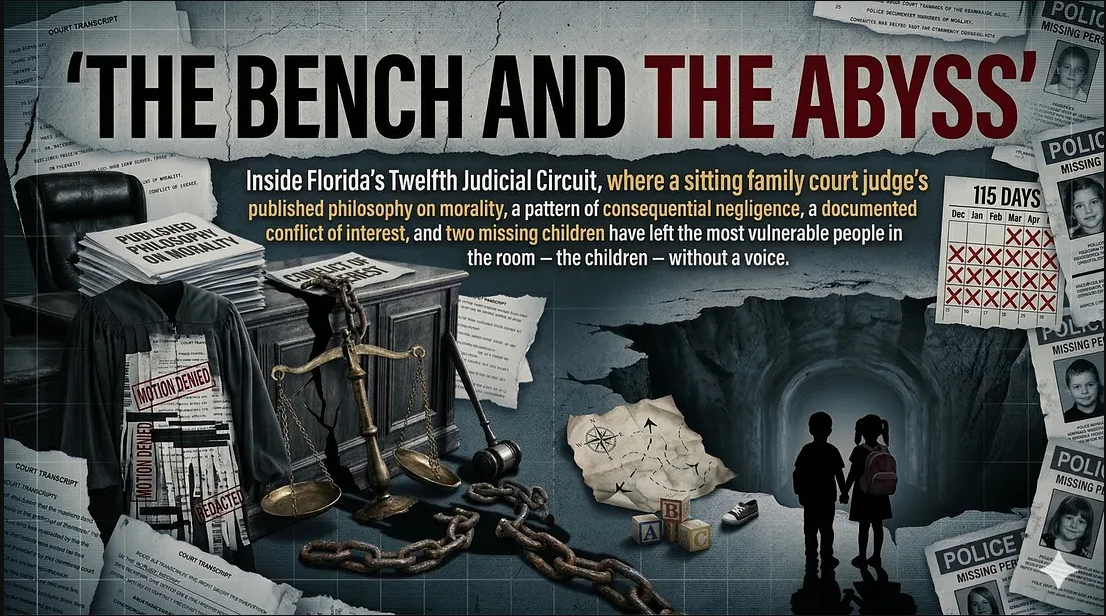
Inside Florida’s 12th Judicial Circuit, where a sitting family court judge’s published philosophy on morality, a pattern of consequential negligence, and a documented conflict of interest have left the most vulnerable in the room — the children — without a voice.
I. A QUESTION OF BELIEF
Let me be clear about something before we begin.
I believe in the justice system. Not naively — but deeply, inherently, in a way that is both American and elemental, etched into the marrow of who we are as a nation. I believe in the judges who show up every day, carrying the weight of decisions that will ripple through families for generations. I believe in the clerks, the bailiffs, the attorneys who understand that practicing law is a privilege, not a given — the ones who are in it for the right reasons, who take ethics seriously, who actually give a damn. I believe in the ideal so fiercely that I cannot, will not, stay silent when it is desecrated by those entrusted to uphold it.
Because here’s the truth: justice is not merely a department of government. It is the organizing principle of this nation. This July 4th, we mark 250 years since the Declaration of Independence — not a legal document first, but a moral one. A declaration that tyranny is wrong, that human rights demand protection, that a government earns legitimacy only by honoring that commitment. Justice wasn’t incidental to the founding; it was the argument, the very backbone.
No other country proclaims it so loudly, so insistently. We put it on our buildings, teach it to our children, hold it up to the world as the essence of who we are. That pride — that patriotic resonance — does not stem from geography or GDP. It comes from the promise: a promise that lives or dies in courtrooms like the ones we are about to discuss.
If we do not actively uphold the integrity of justice- if we allow it to become twisted, corrupted, or neglected — then what, precisely, are we proud of? Without justice that is real, consistent, and applied with integrity, the foundation collapses. The pride becomes hollow.
I cannot hold that belief and remain silent. Not out of cynicism. Not out of politics. But out of love — because those who care most about something are exactly the ones who refuse to watch it be quietly destroyed from the inside.
This is accountability. This is necessity. Because someone has to do it.
When the system fails the people who depend on it most, it is not a procedural glitch. It is a wound to the promise upon which this country was built.
II. WHAT’S AT STAKE: THE SCIENCE FIRST
Before we get to names, cases, and courtrooms, let’s talk about what actually happens to a child when the system fails them. Because this is the part that gets lost — buried in legal filings and procedural arguments and jurisdictional squabbles that make the adults in the room feel busy while the most important thing in the room gets overlooked.
Developmental neuroscience is unambiguous: the period from birth to age five is the single most critical window of human development. The brain is building its fundamental architecture — attachment systems, stress response, language acquisition, emotional regulation. What happens during those years doesn’t just shape childhood. It shapes the entire trajectory of a human life.
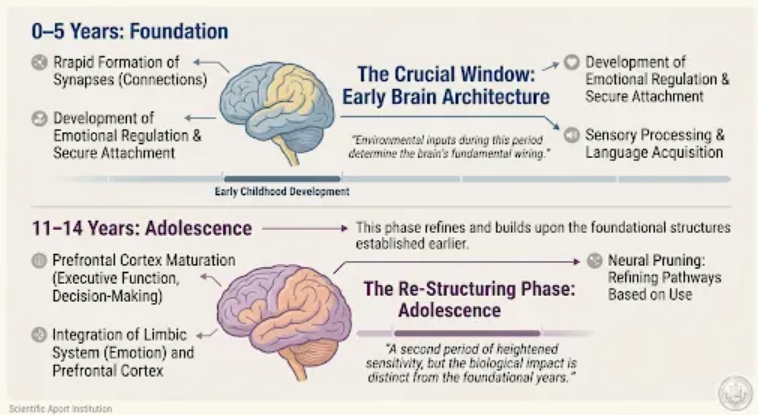
The biological cost of delay. Science shows that disruptions between birth and age five shape the entire trajectory of a human life — wounds that no subsequent court order can heal. -Photo Credit Spotlight Sarasota
The second most critical window? Early adolescence. Roughly ages eleven to fourteen. Identity formation. The consolidation of self-worth. The period when children are working out, at a neurological level, whether the world is safe, whether adults can be trusted, whether they matter.
Disrupt either of those windows — through trauma, instability, separation from a primary attachment figure, or exposure to unsafe adults — and the consequences are measurable, documented, and lasting. We are talking about DSM-5 criteria. Adjustment disorder. Anxiety. Behavioral dysregulation. Attachment disruption that follows people into adulthood, into their own relationships, into the next generation.
Family court judges hold these developmental windows in their hands every single day. Every ruling. Every delay. Every order that prioritizes procedural technicality over a child’s immediate safety is a decision made inside one of these critical periods. And unlike most decisions in the legal system, these cannot be undone by a subsequent order, an appellate reversal, or a settlement.
You cannot give a child back the brain architecture that formed in their absence from safety.
That is not an abstraction. That is a child’s brain. And it demands to be treated accordingly.
III. SARASOTA CAN AFFORD BETTER
Let’s dispense with one argument before it gets made: nobody in this system is underpaid.
Sarasota County consistently ranks among the highest per-capita income areas in the state of Florida — number two by some measures. The compensation structure for public officials reflects that reality. Circuit judges begin at $196,898 annually, plus more than $35,000 in comprehensive family healthcare coverage and pension contributions. A proposed increase would lift the base to $210,878 next year.
That figure is not a complaint; it is a benchmark. It reveals what this county values and what it is willing to pay for competent, accountable public service.
The judges sitting on the family court bench in this circuit are not overwhelmed public servants scraping by on inadequate salaries in an underfunded system. They are well-compensated professionals operating in one of the wealthiest metros in the state, backed by the full weight of judicial authority and the automatic presumption of respect that descends the moment they put on that robe.
That presumption should be earned. Every single day. Not granted in perpetuity at confirmation and never revisited.
Because when it isn’t — when the robe becomes a shield rather than a symbol of something sacred — the people who pay the price aren’t sitting on the bench. They’re in the waiting room. They’re ten months old, running a fever, somewhere their mother can’t find them, on an antibiotic regimen that nobody thought to continue.
IV. ONE HUNDRED AND FIFTEEN DAYS
I want you to sit with a number for a moment.

One hundred and fifteen days. The time it took for a system to return two daughters to their mother after they were taken by a man with a documented criminal history involving minors. — Photo Credit- Spotlight Sarasota
One hundred and fifteen days.
That is how long a mother in South Sarasota County went without seeing her daughters — one of whom was ten and a half months old, the other two and a half years old — after their father, who had never established paternity by operation of law, had never paid a single dollar in child support, and had never exercised a single day of formal visitation, convinced her to let him take the girls to a birthday party.
The ten-month-old had a severe ear infection. She was on antibiotics. Her mother did not send the medication because she had no reason — none — to believe her daughters were not coming home.
They didn’t come home.
For one hundred and fifteen days, this mother — a young woman without so much as a traffic citation, no substance abuse history, no mental health concerns, no criminal record of any kind — did not know where her children were. He had recently relocated and deliberately withheld his address. For the entirety of those four months, the residential location of a man who had absconded with two small children remained unknown to their mother.
He had just been released from jail.
What she could not have fully known then — what would only become visible through the court record — was the history she had trusted her daughters into. He had documented sexual battery charges on his record. The victims were minors. They were related to him by blood. The probable cause affidavit — filed within this very court, the 12th Judicial Circuit, and handed to the presiding judge as index evidence — contained details so revolting they were redacted to protect the identity of the child victim. That affidavit. That record. That history. All of it was before the bench.
I was personally involved in the effort to help her. What I witnessed was not bureaucratic indifference at its most neutral — it was active hostility dressed up as procedural neutrality. We faxed and emailed everyone we could reach: up to and including Governor DeSantis’s office, Shevaun Harris at DCF, the DCF Inspector General. We got a DCF supervisor on the phone. Her response, upon being told that a mother did not know where her two young daughters were, was something close to this:
‘Well, we know where they are. Maybe the mother shouldn’t have allowed the babies to go if she didn’t have the address.’
It is legally impermissible to conceal children from a parent in this manner. Documents were filed within the court to that effect — to no immediate avail.
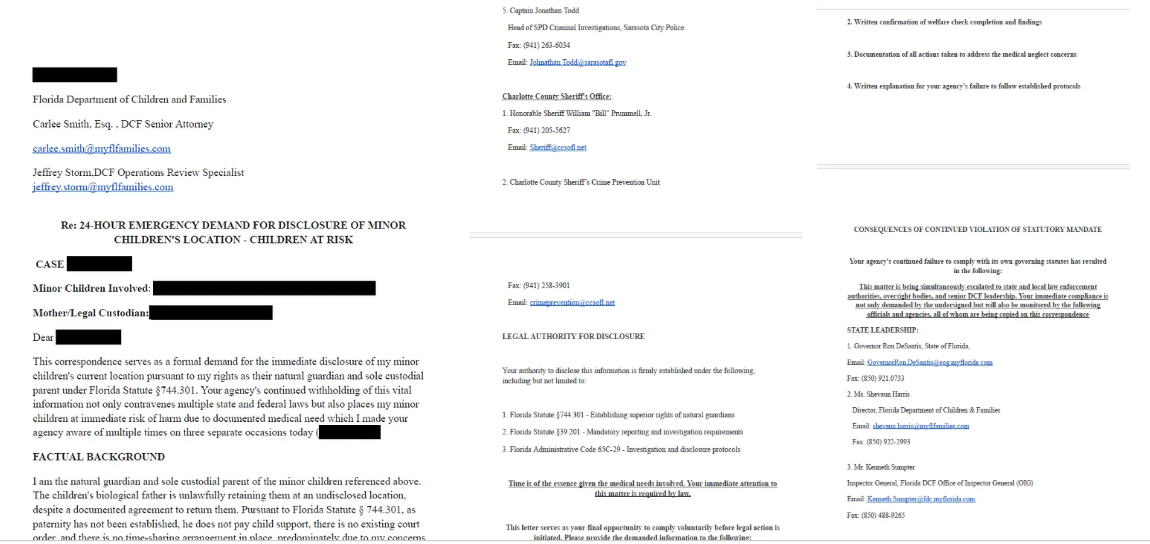
Redacted copies of communications sent to DCF prior to legal filing, all to no avail. Photo Credit: Spotlight Sarasota
It was not until April 10th — December 11th to April 10th — that this mother held her daughters again.
That is four months. One hundred and fifteen days. Across two of the most critical developmental windows science has ever identified. For both of them. Gone.
That is four months. One hundred and fifteen days. Across two of the most critical developmental windows science has ever identified. For both of them. Gone.
V. WHAT HAPPENED IN COURT
When this mother was finally able to get before a judge, she had already been failed once before she walked through the door.
The clerk of court — who is prohibited by law from providing legal advice — directed her to file a specific form. It was the wrong form for her circumstances. It was not the form that matched the emergency nature of what had been done to her family. By the time the correct procedural posture could be established, the case had been structurally undermined before it began. Not maliciously, perhaps. But consequentially.
The judge presiding over the emergency pickup order hearing did not address the pickup order.
Let that sit for a moment.
She had before her a documented sexual predator. A man whose charges involved minor victims related to him by blood. A man who had just spent one hundred and fifteen days deliberately concealing the location of two small children from their mother. A ten-month-old and a two-and-a-half-year-old who had never spent a single night away from home before — one of whom had spent those one hundred and fifteen days without her prescribed antibiotics, because she was never supposed to have been gone long enough for it to matter.
The judge did not engage with any of it. Four to five pending motions — placed on the docket on an emergency basis, specifically to ensure they would be reviewed, specifically to remind the court why this hearing had been called — were ignored. This was not a routine timesharing dispute. This was not a paternity determination. The emergency pickup order appeared as docket item number one. It was never addressed.
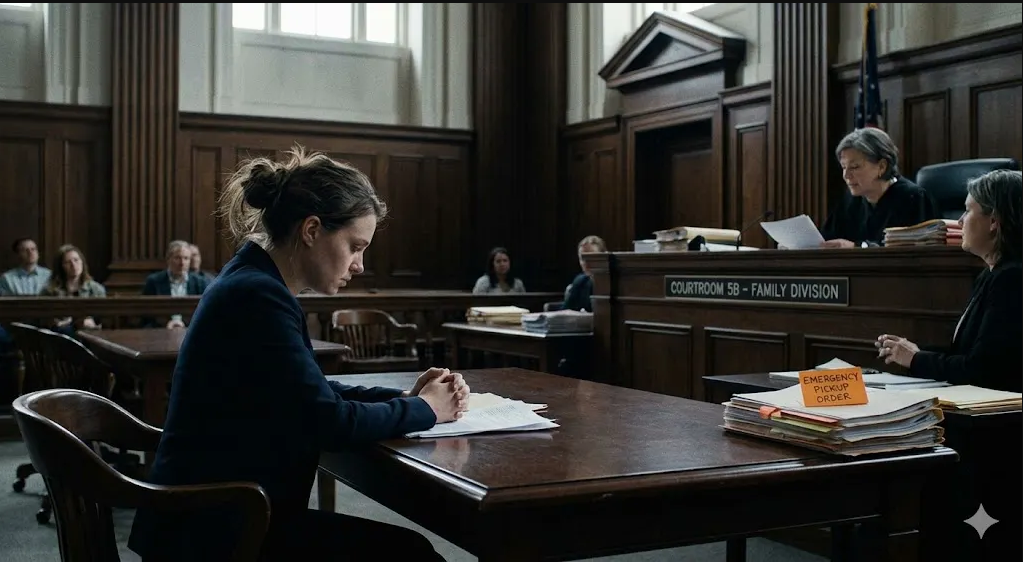
The young mother sat there and felt what most people feel in those rooms: pressured, small, uncomfortable. It is an intimidating environment by design — associated with authority, with people who hold extraordinary power over the most intimate dimensions of our lives. But there is a difference, a morally significant difference, between a court that is intimidating because it is serious and a court where the intimidation becomes the point, where the architecture of authority substitutes for the substance of justice.
But there is a difference, a morally significant difference, between a court that is intimidating because it is serious and a court where the intimidation becomes the point, where the architecture of authority substitutes for the substance of justice.
She had reached out to every government agency available to her — DCF, law enforcement, legal authorities at every level — and been met, at each turn, with indifference, incompetence, or contempt. DCF had shamed her. The court had ignored her emergency. The system, in its totality, had looked at the facts of this case and produced the outcome it produced. This is not a series of unrelated failures. This is a pattern.
Consider, for a moment, the specific medical reality of what happened to that ten-month-old while she was gone. The man who took her — the biological father, who had never cared for her, whose sole demonstrated engagement with children prior to this moment was documented in a criminal file — did not take her to her pediatrician when her infection persisted. He did not call the pediatrician. He took her to a walk-in clinic.
An infant on a prescribed antibiotic regimen, taken by a stranger to an unfamiliar provider, without records, without history, without any continuity of care. At that age, those are not hypothetical risks. A failed antibiotic course. An undisclosed allergy. These are documented, foreseeable medical concerns — and not a single adult in a position of authority treated them as such. That is gross negligence. That is wanton disregard for the best interests of a child.
The common law doctrine of parens patriae — the state’s authority to act as guardian for those who cannot protect themselves — exists for precisely this reason: to ensure that when the system must adjudicate between competing parental claims, the welfare of the child is the lodestar. Not procedural convention. Not administrative efficiency. Not the comfort of the adults in the room. The child.
The State Attorney’s Office of the 12th Judicial Circuit had itself produced a formal charging document — signed by the State Attorney — containing specific, revolting details about what this man had done to a child in his own family. That document was before the bench. The judge reviewed what was in front of her and rendered her decision.
The judge awarded 50/50 timesharing. To him. I have sat with that outcome for a long time. I have turned it over, looking for the logic, the legal reasoning, the procedural justification that makes it make sense. I haven’t found one.
What I have found instead is a pattern — not a conspiracy, not some coordinated effort against any particular family, but something almost more troubling than that: a pattern of profound, recurring, consequential negligence in cases where children cannot afford for the adults in the room to be negligent.
VI. IT’S NOT JUST HER
I want to be careful here, because I’m aware of how this can sound. Bitter. Conspiratorial. Like someone who lost in court and decided the system was rigged. That framing would be both inaccurate and convenient — convenient because it allows the system to dismiss the messenger without engaging the message.
So let me be precise: I have navigated civil litigation in this circuit myself. I have encountered fraud upon the court in a personal matter and handled it through proper channels. The matters in my own life have not gone uniformly against me. My perspective is not born of loss. It is born of sustained attention — nearly three years now, of watching how this system operates in case after case and finding the same structural failures repeating themselves with a regularity that cannot be explained by bad luck.
I know a man in Sarasota County — a father — who has been separated from his daughters without legal justification. Parental alienation documented and ongoing.
He has now carried legislation to both chambers of the Florida legislature: a bill that clarifies the often vague, inconsistently applied, routinely unenforced statutes within Chapter 61, which governs timesharing, child support, and enforcement. He drafted it himself. He navigated the nuanced technicalities of that entire statute chapter alone. He is making significant progress.
I remember speaking with him and recognizing, in his trajectory, something I have seen before: the origin story of someone who went through something so incredibly painful that they felt compelled to stay on the mission forever. He is not alone in that compulsion. There are more like him than the system wants to acknowledge.
This is not a gendered issue, and I will not allow it to become one. Bad outcomes in family court destroy fathers and mothers with equal devastation. They destroy children regardless of which parent they are being weaponized against. The common thread is not gender. It is power — specifically, the power that flows from judicial tenure and institutional insularity, untempered by the accountability that every other consequential profession demands.
But here is what haunts me about those conversations: so much of this could be prevented. So much of the harm documented in this report — and in the broader pattern it reflects — is flagrant, easily identifiable, and entirely avoidable. We are not talking about close calls. We are talking about cases where the evidence of danger was explicit, documented, and in front of the court.
VII. THE JUDGE: A CLOSER LOOK
Kevin R. Bruning has sat on the family court bench in the 12th Judicial Circuit long enough that his influence on local legal culture has become structural. Attorneys calibrate their arguments to him. Courtrooms, over time, bend toward a judge’s known tendencies. That is not sinister — it is simply how institutions work. Tenure creates gravity. Gravity shapes the field.
But to understand Kevin Bruning, you first have to understand who preceded him.
THE FATHER: A LEGAL CAREER BUILT IN FIRE
Richard C. Bruning is, by any honest measure, a legal unicorn. Born in the 1940s, his career traced a path so rare that the odds of assembling it are nearly impossible to calculate.
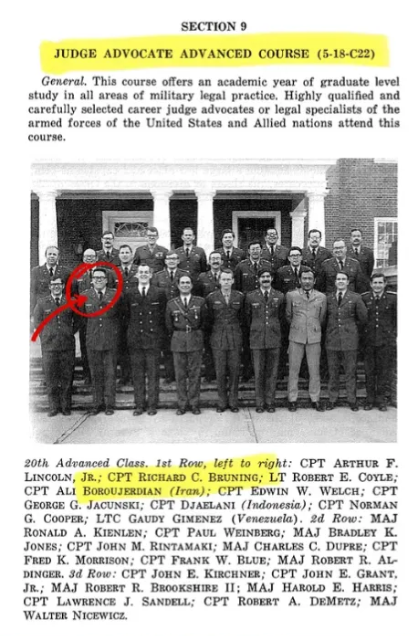
Richard C. Bruning (the father): a “legal unicorn” whose career spanned wartime justice and federal prosecution with a spotless ethical record. Photo Credit- Library of Congress
He served as a military judge in Vietnam — one of perhaps a hundred to two hundred Army JAG officers ever deployed in that capacity across the entire war. He was promoted to Lieutenant Colonel in the JAG Corps, a distinction achieved by fewer than twenty to thirty percent of those who ever made captain. He then transitioned to the Department of Justice as a federal prosecutor during the post-Watergate era, when the hiring rate for qualified applicants was roughly one to two percent of the national pool.
He subsequently moved to the private sector at the highest possible level, serving as general counsel for Lockheed Martin’s Missiles and Fire Control division — one of perhaps fifty to a hundred divisional general counsel positions in the entire American defense industry at any given time.
He did all of it with a spotless record. No ethics complaints. No scandals. Just quiet, sustained, extraordinary excellence — bridging battlefield justice, federal prosecution, and boardroom strategy across three distinct eras of American legal history. By any statistical measure, Richard C. Bruning occupied the top 0.01 percent of all practicing attorneys in the United States.
Most lawyers spend an entire career in one of those worlds. Richard C. Bruning conquered all three — as a wartime judge, a federal prosecutor, and general counsel for one of the most powerful defense contractors in the country. His son chose to write 17,606 words about nude dancing.

Kevin R. Bruning (the son): the published intellectual foundation of a sitting judge — 17,606 words arguing that morality has no legitimate place in a courtroom. A legacy inherited and a philosophy applied: while one built a career on institutional excellence, the other used his scholarship to argue against the very moral standards he now adjudicates.
THE SON: A DIFFERENT KIND OF LEGACY
Before he was a family court judge, before he was the man whose presence structures the legal culture of Sarasota’s most consequential bench, Kevin R. Bruning was a Stetson University law student with a thesis to write. And in 1999, he wrote it — at length. Seventeen thousand, six hundred and six words’ worth of length, to be precise.
The citation is 29 Stetson L. Rev. 775 (1999–2000). The author: Kevin R. Bruning. The title: Nudity and Alcohol — Morality Lies in Public Discussion.
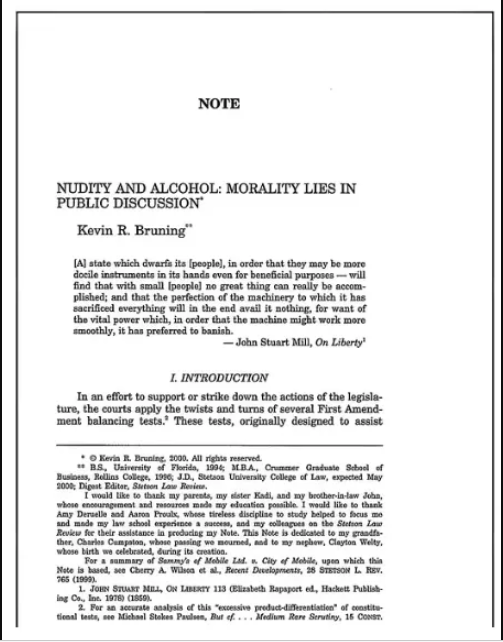
The published intellectual foundation of a sitting judge: 17,606 words arguing that morality has no legitimate place in a courtroom. 29 Stetson L. Rev. 775 (1999–2000), Kevin R. Bruning
Yes. You read that correctly.
The man who would go on to preside over the family court bench in the 12th Judicial Circuit — a court whose entire legal mandate orbits around the best interests of children, the fitness of home environments, the moral suitability of the adults in a child’s life — spent the intellectual culmination of his legal education crafting a 17,606-word argument in passionate defense of nude dancing and its constitutional right to coexist with alcohol service.
Now. Academic freedom is real. Law students are trained to argue assigned positions. People are entitled to evolve over a career. But this was not a moot court exercise. This was not an assigned position in a compelled brief. This was a published law review article — considered, researched, voluntarily submitted as the capstone document of his legal education. His name on it. His argument. His manifesto.
And it is, in its own way, a remarkable piece of work.
Bruning opens by arguing that nude dancing — provided it stops short of legal obscenity, whatever the courts happen to be treating as the line on a given day — constitutes protected expressive conduct under the First Amendment.
Non-obscene nude dancing,he writes, “encompasses a recognized message of sexuality and eroticism,” and courts have struggled “with satisfying the Supreme Court’s negative attitude towards nude dancing in light of contrasting tests that protect nude dance as a form of expression.”
He then goes further. Nudity, he argues, is not merely incidental to the performance. It is the point. It “enhances the erotic message being conveyed.” And because that erotic message constitutes protected expression, he contends that any law targeting nude dancing should be subject to heightened constitutional scrutiny.
Throughout the 17,000-plus words, Bruning deploys sexually charged legal metaphors with what can only be described as relish — at one point announcing his intention to “undress the origin of the problem.” He was clearly having fun. Less fun, perhaps, in retrospect.
He describes the law he’s challenging as one that permits — and I quote directly — a “nude waitress in a pub on a 50-cent beer night to serve a bar full of people,” so long as she is not performing. He argues, with equal indignation, that those same laws would technically prohibit a theater from screening a film depicting “the atrocities of World War II, briefly depicting the naked bodies of prisoners of war” — if that theater happened to serve alcohol. He openly mocks the courts for equating a ban on “bare buttocks” with the prevention of gross sexual acts and “bacchanalian revelries.”
Bruning goes further still. Because there is no “empirical connection” between a person’s morality and the public welfare, he argues, any law claiming to benefit public morality cannot be scientifically or factually tested. And if a governmental purpose cannot be observed or proven, it also cannot be disproven — producing what he calls a governmental checkmate: a legal catch-22 in which morality-based justifications become effectively bulletproof precisely because they exist outside the realm of evidence.
He is not subtle about what he thinks of courts that accept such reasoning. Judges who rely on moral justifications are not performing an honest balancing of rights, he writes — they are engaged in “judicial activism, swinging a broad hammer of morality,” systematically “chipping away at First Amendment freedoms by prioritizing moral taste over constitutional protections.”
“Judicial activism, swinging a broad hammer of morality, chipping away at First Amendment freedoms by prioritizing moral taste over constitutional protections.”
— Kevin R. Bruning, 29 Stetson L. Rev. 775 (1999–2000)
It is, I will admit, a fascinating piece of writing. Genuinely argued. Occasionally funny. Legally creative.
It is also the published intellectual foundation of a sitting family court judge — a judge who has spent years deciding what moral environment is fit for a child, whose rulings on parental fitness carry the full authority of the state of Florida. A judge who, at some point, apparently decided that the world didn’t need easy access to seventeen thousand words documenting his thoughts on bare buttocks, bacchanalian revelries, and the constitutional sanctity of the nude waitress.
The thesis has been scrubbed. It takes some digging to find it now. If you believe in something enough to write 17,606 words about it at the outset of your legal career, why spend the back half of that career trying to make sure nobody reads them?
The answer, perhaps, is this: the cognitive distance between arguing that nude dancing deserves First Amendment sanctuary from morality-based regulation and presiding daily over cases where the central legal standard is the moral fitness of a parent’s home environment is not a distance that narrows on its own. It requires active management. It requires that the thesis remain buried.
Richard C. Bruning built a legal career that will outlast the institutions he served. His son inherited the name, the pedigree, and the platform — and used his first major act of legal scholarship to argue, at length, that morality has no business in a courtroom.
A man who once wrote passionately about courts doing violence against the First Amendment now sits in a position to do considerable damage of his own — against families, against children, against the very constitutional protections he once claimed to revere — with far less eloquent justification and far less public scrutiny than a law review article ever received.
That asymmetry is worth noting. And the Trellis data only deepens it. The rate at which cases from this bench have required review by the District Court of Appeal is not the mark of a judge whose rulings consistently hold up under scrutiny. Appellate review in family court isn’t routine housekeeping — it’s what happens when a party has exhausted every other option and determined that what occurred at the trial level was wrong enough to fight. It costs money. It costs time. It costs families months, sometimes years, of additional litigation at the worst possible moment in their lives. And it has happened, in cases originating from this bench, with a frequency that the Trellis data makes difficult to ignore.
E.M. v. E.G., 341 So. 3d 1151 (Fla. 2d DCA 2022), answers it in the particular. In that case, Florida’s Second District Court of Appeal reversed a Bruning ruling that had imposed supervised visitation on a mother — finding that it lacked any factual findings to support it and no evidence in the record to justify it. The appellate court’s language was not ambiguous: there was nothing there. A constitutional violation of a mother’s fundamental parental rights was reversed. A child’s access to her mother was restored. The ruling that severed it had no basis. That this published opinion reflects something larger than a single error is not a speculative claim — it is a conclusion that a systematic review of cases originating from this bench would bear out — and it deserves a public answer.
VIII. THE EVIDENCE SHE WANTED
Two children were being unlawfully retained by non-custodial third parties who had no legal rights and no lawful justification for doing so. While being held, the children were exposed to occult imagery by the very individuals detaining them. When their mother brought this to the attention of Nia Sharan, the attorney representing those individuals, Sharan’s first response was to ask for better-formatted screenshots.
There is a moment in the audio recording of that phone call that is chilling.
It lasts roughly ten seconds. In it, you can hear the precise moment Attorney Sharan’s tone shifts — a snap, a chill, a faint curl of condescension that is somehow more revealing than anything she actually says. A mother has just raised a concern about her child. What follows is not reassurance. It is not even the performance of reassurance. It is a wall going up, fast and hard, from a lawyer who understands exactly how damaging the underlying facts are for her clients — and has apparently decided that the most effective response is to redirect the conversation toward paperwork.
The mother on that call was not dealing with an abstract legal dispute. She was dealing with something far darker. Her children — young children — were being unlawfully retained. And while they were being held, according to photographs that had surfaced in the matter, Sharan’s clients had been drawing occultist imagery around them. Pentagrams. The number 666. Dark, deliberate symbols rendered in the physical space surrounding small, frightened children who had no ability to leave.
Those children were already frightened. Then they were subjected to this.
And when the mother raised it — when she brought the trauma of her child’s exposure to this imagery into a phone call with the attorney representing the people responsible — Sharan did not pause. Did not soften. Did not offer a single syllable acknowledging a child’s psychological harm as a thing worth addressing.
She went on defense. Immediately. Audibly.
What followed was, depending on your tolerance for legal absurdity, either remarkable or clarifying. Sharan launched into an explanation — rambling, halting, riddled with false starts — of why she needed the screenshots formatted a particular way. The logic, such as it was: text message evidence presented in court must include the sender’s phone number and the name under which they were saved in the recipient’s contacts. Otherwise, she explained, the message could have come from anywhere.
Here is how she said it, in her own words, from the recording:
“I’m requesting… I don’t know what you name — what you had — your name — your son saved as his name — so in a court of law, in evidence, when we produce text messages in court as evidence, we have to show -that — that person’s phone number is there and whatever name that person’s was saved under the phone — because it shows that it’s from that person — otherwise that text can come from anywhere.”
Set aside, for a moment, the substance. Just read the syntax. The stuttering. The self-interruptions. The sentence that simply trails off — “whatever name that person’s was saved under the phone” — without ever arriving at its grammatical object. This is not the crisp procedural confidence of an attorney who knows exactly what she needs and why. This is someone constructing a justification in real time, talking fast to fill silence, for a request she has not fully thought through.
And the justification doesn’t hold. This is not how metadata and chain of custody actually work. Text message authentication is established through device records, carrier data, metadata embedded in the message itself, and corroborating context. The claim that a screenshot is inadmissible simply because the sender’s contact name isn’t visible is not a serious statement of evidentiary law. It is lawyer-splaining — the deployment of technical-sounding language toward a non-lawyer in a way that sounds authoritative and isn’t.
She continued:
“What I’m saying is I need you to screenshot of this ‘person’s’ drawing 666 that your son sent you, with his name and number on that screenshot, so I can see that it was your son who sent this picture to you.”
Note the rhetorical architecture of that sentence. Not her client. Not the person accused of drawing occult symbols around imprisoned children. This person. Anonymous. Clinical. Accountability scrubbed from the sentence before it ends.
The mother, at this point, responded the way most people respond when a professional has delivered a confident-sounding explanation that doesn’t quite track but arrives with enough velocity to feel authoritative:
“Yeah, that makes perfect sense. I can do that. Do you want me to email it?”
It didn’t make perfect sense. But that is what the dynamic in that room — or on that call — produces. A mother of detained, traumatized children, deferring to the attorney defending the people who detained and traumatized them, agreeing to jump through evidentiary hoops that aren’t even real evidentiary hoops.
What the recording captures, in those ten seconds and the minutes that follow, is not merely an attorney failing to express concern for a child. It is something more specific and more troubling: an attorney who, confronted with the human reality of what her clients had done — the unlawful detention, the imagery, the terror these children experienced — chose to redirect the conversation entirely. To make it procedural. To make it about screenshots and contact names and email attachments.
To make it, in other words, about anything other than two small children who had been subjected to occultist rituals by the people who were supposed to be caring for them.
The snap in Sharan’s voice when the mother first raised the concern is audible. The condescension is audible. And beneath both — if you listen closely enough — is something else: the sound of a lawyer who knows precisely what she is defending and has decided that the only viable path forward is to not look directly at it.
When a mother tells you her child was terrified. When photographs exist of your clients drawing satanic imagery around small children they were unlawfully holding. When the human cost of the case is sitting right there on the other end of the phone — what kind of lawyer hears all of that, and asks for better screenshots?
The recording answers the question. Someone in a position of authority just has to be willing to listen to it.
This publication reviewed a recorded conversation and a ten-second audio clip in which the above exchange took place. All quoted dialogue has been reproduced verbatim from those recordings.
IX. A FOOTNOTE THAT WRITES ITSELF
A law student wrote his thesis arguing that morality has no legitimate place in legal judgment. Two decades later, as a judge, he had a chance to prove it. He did.
In August 2018, a Sarasota County Sheriff’s deputy responded to a call at the intersection of Bahia Vista and Love Street. What he found there reads, in his patient and measured probable cause affidavit, like a scene assembled from several different disasters at once.
There was a vehicle. Positioned half on the median, half in the road. Both front tires blown out. Behind the wheel sat an attorney.
She was in her undergarments.
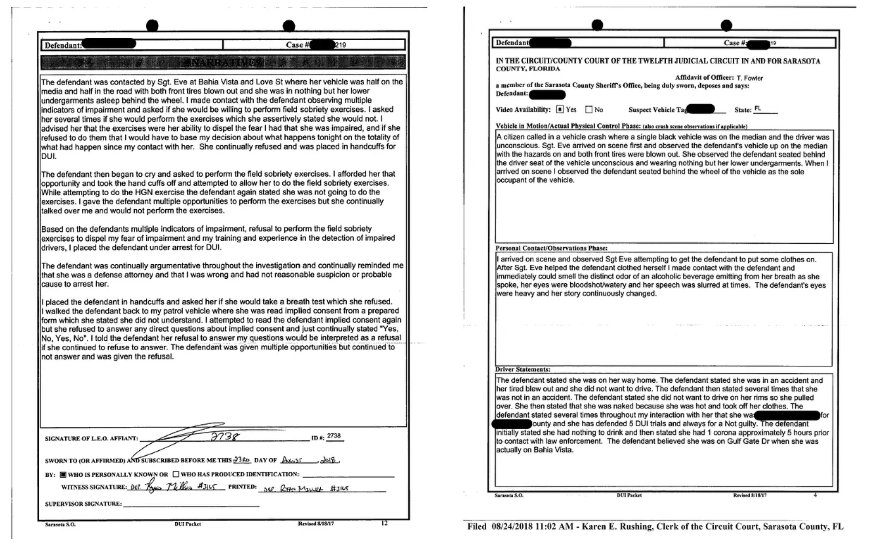
Multiple indicators of impairment were noted. She refused field sobriety exercises. She refused the breathalyzer. She told the deputy — repeatedly, with what the affidavit records as apparent conviction — that he had no probable cause, that she was a defense attorney, and that he was wrong. The affidavit was filed with the Sarasota County Clerk on August 24, 2018, with the equanimity of someone who has learned not to be surprised. She was arrested for DUI.
That was the first one.
Five days after being sentenced for the conduct arising from that night — five days — she was arrested again. Same charge. Refused the breathalyzer again. Witnesses had observed her strike a curb. This time, there was a conviction.
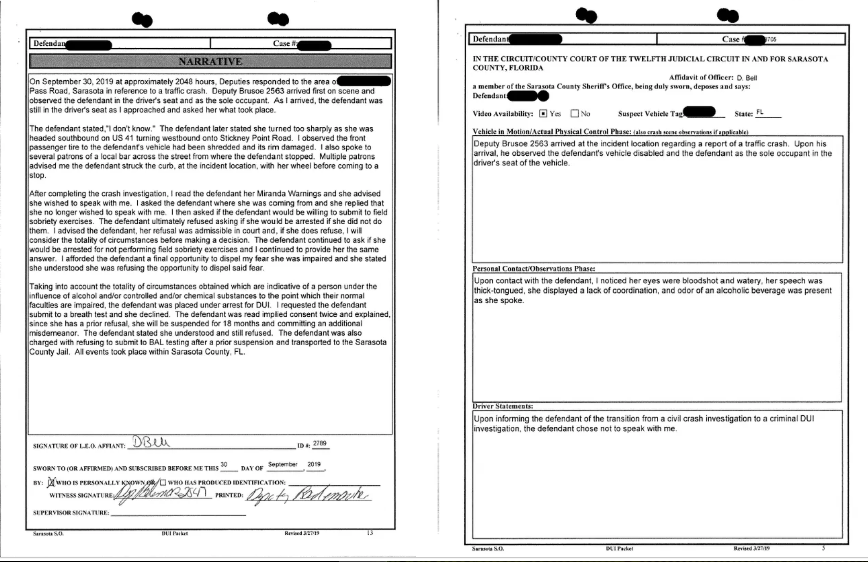
She was not, by any reasonable reading of the record, a first-time offender having an anomalous bad year. Her documented history stretched back to 1994 and spanned multiple counties — at least twenty-seven law enforcement contacts since the age of eighteen, excluding traffic citations entirely. Among the earlier entries: a 1995 charge for delivery of a controlled substance to a minor. Not possession. Not use. Delivery — to a child. And a 1999 stalking charge initially classified as a third-degree felony.
Not a streak of bad luck. A pattern.
The 1995 charge alone warrants pause. Probable cause had to be established. A finding had to be made that sufficient evidence existed to support it. Whatever the ultimate disposition, the conduct was serious enough that the state of Florida saw fit to pursue it — and it did not occur in isolation. It was one entry in a pattern spanning three decades, sustained at nearly one contact per year across her entire adult life.
Two decades after that record began accumulating, this attorney was practicing in a family court whose sole constitutional mandate is the safety and well-being of minor children. Not a peripheral role. Not administrative. In the room. In the cases. Arguing positions that directly shaped outcomes for the children that court exists to protect.
The Florida Bar reviewed the record in full.
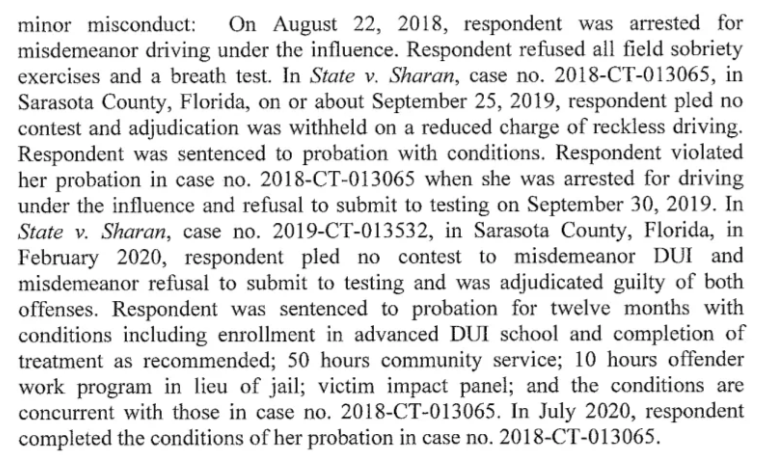
Their finding: minor misconduct. An admonishment. Monitoring fees. Back to work.
The committee chair who reviewed that record — who weighed twenty-seven law enforcement contacts spanning three decades, two DUI arrests within five days of each other, a conviction, and a probation violation almost immediately after sentencing — and concluded that what he was looking at constituted minor misconduct?
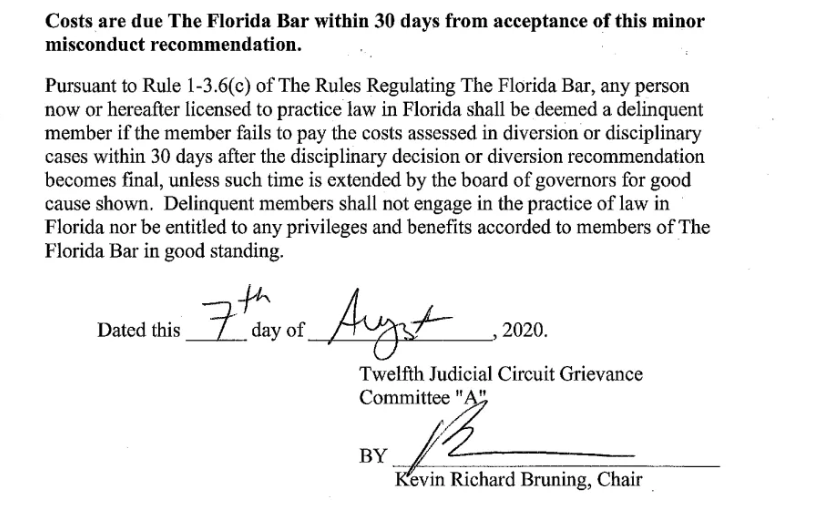
Kevin Richard Bruning.
Author of Nudity and Alcohol — Morality Lies in Public Discussion.
It would be too easy, and probably unfair, to draw a straight line from a law school thesis to a judicial ruling two decades later. People write things in graduate school that they don’t spend their careers enacting. There is no documented evidence of a prior personal relationship between Bruning and the attorney whose record he reviewed — no relationship that would have legally required recusal. Administrative assignments happen. Circuits are small. Florida’s legal community is smaller than it looks from the outside.
All of that can be said. All of it is true.
And yet.
Here is a man who spent seventeen thousand words arguing that moral judgment has no legitimate place in legal standards — that nudity and alcohol, taken together, constitute a pretext courts deploy when they want to suppress what they find distasteful rather than what is genuinely harmful. Here is that same man, in his first year on the bench, confronting an attorney found in her undergarments and impaired on a public median, arrested for drunk driving not once but twice within the same week — and arriving at the conclusion that what he was looking at was minor.
The thesis was not merely an academic exercise. It was, it turns out, a philosophy. And in 2019, Kevin Bruning had an opportunity to apply it.
He did.
The attorney paid $350.
Within a year of the committee’s finding, she changed her name. Nitti Sharan became Nia Sharan.

According to available records, Nitti Sharan attempted to navigate around Florida’s mandatory FDLE disclosure requirements legal name change, but the effort was ultimately unsuccessful.
According to available records, the name change application in September 2020 did not fully disclose her criminal history to the court, in apparent tension with Florida’s FDLE disclosure requirements governing legal name changes. The effort was ultimately unsuccessful.
The name changed. The record did not.
At the time of this writing, Attorney Nia — also known as “Nitti” Sharan — continues to practice within Bruning’s circuit and continues to handle cases involving children.
The thesis was titled Morality Lies in Public Discussion.
He was not wrong about where it lies. The difficulty is that Bruning appears to have concluded it should stay there.
Criminal records, Bar disciplinary findings, court filings, and the published law review article cited throughout this report are matters of public record. All characterizations of conduct in this report are drawn from those documents.
X. THE COST OF INACTION
The cases documented in this report are not aberrations. They are illustrations of a pattern — and patterns have endpoints.
In the course of reporting this piece, two mothers came forward independently. Different counties. Different judges. Different years. The details of their cases are their own, and their daughters’ stories belong to those daughters alone. What can be said — what both mothers said, in different words, arriving at the same place — is this: they did everything the system asked of them. They documented. They filed. They showed up. They submitted evidence. They followed the process with the faith that the process was designed to protect their children.
It wasn’t enough.
Both girls ran away.
That is where systemic inaction leads. Not always. Not inevitably. But with a documented, measurable frequency that family court reform advocates have been raising for years — the child who cannot file her own motion, cannot retain her own attorney, cannot appeal her own outcome, and eventually stops waiting for the adults in the room to protect her and walks out the door instead.
XI. ACCOUNTABILITY
There are two little girls somewhere in Sarasota County who were too young to speak for themselves when it mattered most. They are older now. The developmental windows disrupted during those one hundred and fifteen days cannot be restored by any subsequent court order, any appellate reversal, any settlement. What formed in their absence from safety — in their brains, in their nervous systems, in the architecture of how they will understand trust and danger for the rest of their lives — is permanent. No ruling fixes it. No admonishment undoes it.
The adults responsible for that outcome are still in their positions.
The judge is still on the bench. The attorney is still practicing, under a new name, in cases involving children. The DCF supervisor who responded to a mother’s desperation by questioning whether she should have allowed it is undocumented in any public record of consequence. The clerk who directed a frightened woman to the wrong form has, in all likelihood, moved on to the next case without a second thought.
The system has continued turning. It does not experience what it inflicts. It does not carry the weight of what it permits. That weight belongs exclusively to the people in the waiting room — the mothers, the fathers, and most of all the children, who never asked to be in any of these rooms and have no mechanism to leave them.
I have said from the beginning that I believe in this system. That belief is not naive and it is not negotiable. It is precisely because I believe in it that I cannot watch it operate this way in silence — again, not out of cynicism, not out of politics, but out of the same conviction that compelled the founders to put justice at the center of everything they were building. They did not put it there as decoration. They put it there because they understood that without it, everything else is pretense.
When the system fails the people who need it most and then continues, unreformed and unaccountable, as though nothing happened — that is not a procedural problem. That is a betrayal of the premise.
These two little girls did not get a vote. They did not get a hearing. They did not get a guardian ad litem who fought for them, a DCF supervisor who treated their location as urgent, a clerk who knew the right form, or a judge who looked at what was in front of her and responded to it with the gravity it demanded.
What they got was one hundred and fifteen days.
The system that produced that outcome is still running. The people who made it possible are still in place. And the children — older now, carrying whatever those months left inside them — have received no acknowledgment from any of the institutions that failed them. No accounting. No correction on the record.
This report is not that accounting. It is the beginning of the argument that one is required.
This was accountability. This was necessity. Because someone had to do it.
EDITOR’S NOTE
Criminal records, Florida Bar disciplinary findings, court filings, and the law review article cited herein — 29 Stetson L. Rev. 775 (1999–2000) — are matters of public record. All characterizations of conduct in this report are drawn exclusively from those documents. The audio recording and quoted dialogue referenced in Section VIII were reviewed directly by this publication and reproduced verbatim. No individual named in this report has been contacted for comment prior to publication of this version; a right-of-reply request will accompany formal publication. Nothing in this report constitutes legal advice.