Abandon All Hope: Florida’s Charter Takeover
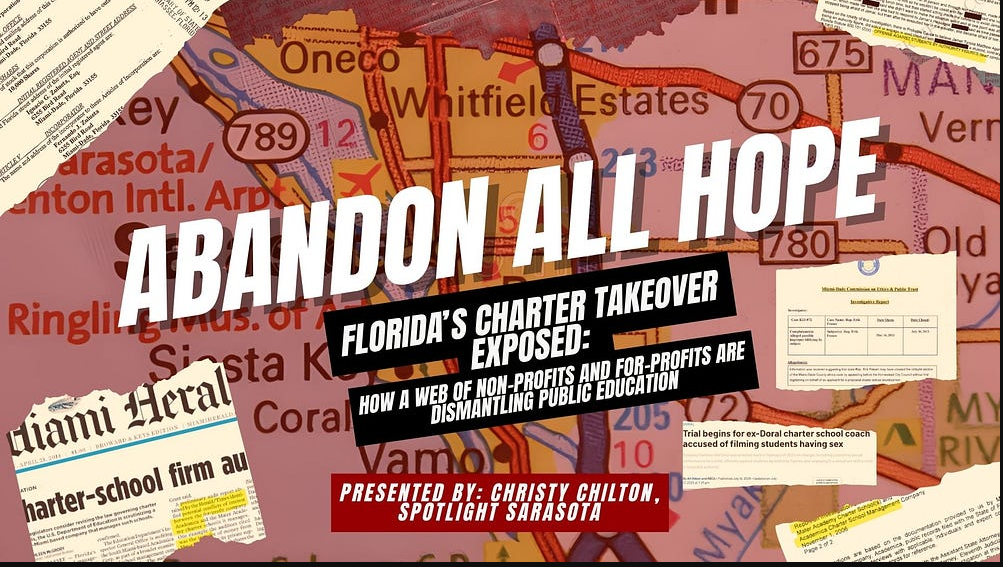
How a Web of Non-Profits, For-Profits, and Political Cronies Are Dismantling Public Education One Vulnerable School at a Time
Inside a 27-year empire built on self-dealing, opaque finances, and legislative sleight-of-hand — where taxpayer dollars meant for the neediest kids vanish into real estate deals, management fees, and the pockets of a connected few.
-Christy Chilton
Prologue: When Hope Becomes a Threat
The Florida sun hung low and merciless that September afternoon in Sarasota, turning the air into a thick, shimmering veil that clung to skin like regret. Parents edged their minivans into the pickup line at Oak Park School — Sarasota County’s only sanctuary for children with profound physical and intellectual disabilities. This is where roughly 225 students from kindergarten through twelfth grade navigate worlds measured in painstaking milestones: a syllable wrenched from silence, a first unassisted step, a seizure held at bay by a nurse’s vigilant hand.
Imagine the scene: Wide hallways engineered for the graceful arc of wheelchairs. Walls alive with the soft whir of communication devices that cost more than most cars. Sensory rooms bathed in calming blues, stocked with tens of thousands of dollars in adaptive equipment, where physical therapists guide spastic limbs through stretches that feel like battles. The air carries the faint antiseptic tang of feeding tubes and the triumphant giggle of a non-verbal teen finally voicing “mama.” The staff-to-student ratio hovers near one-to-three because some children need a grown-up’s steady grip just to swallow lunch without choking.
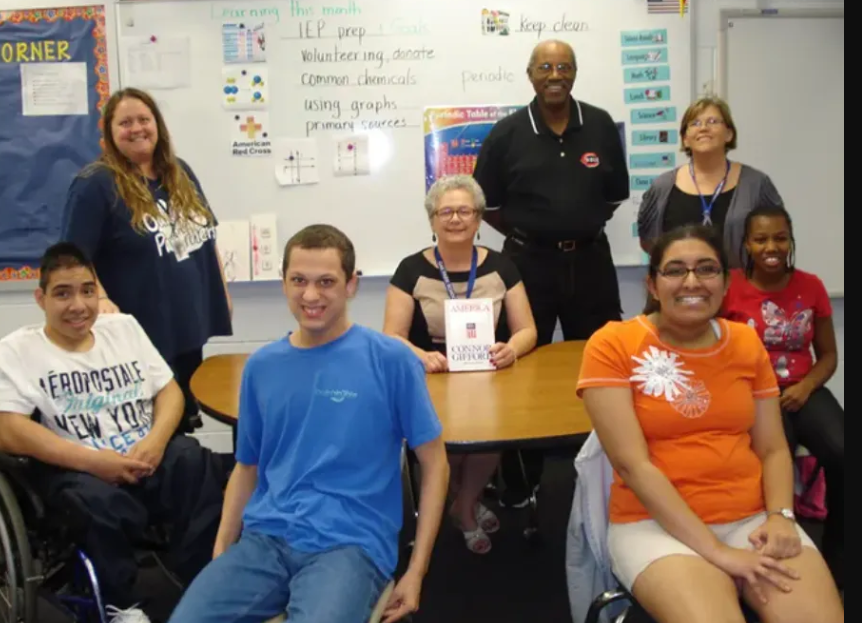
Students and Faculty at Oak Park Elementary School, Photo Credit: Sarasota Herald-Tribune
This isn’t just a school. It’s a fragile miracle stitched together with precision and devotion — a lifeline for kids with cerebral palsy, spina bifida, traumatic brain injuries, severe autism. Occupational therapists rig communication systems. Speech pathologists coax first words from teenagers who’ve spent years silent. This isn’t luxury. It’s survival.
Then, in October 2025, the notice arrived — like a thunderclap in paradise.
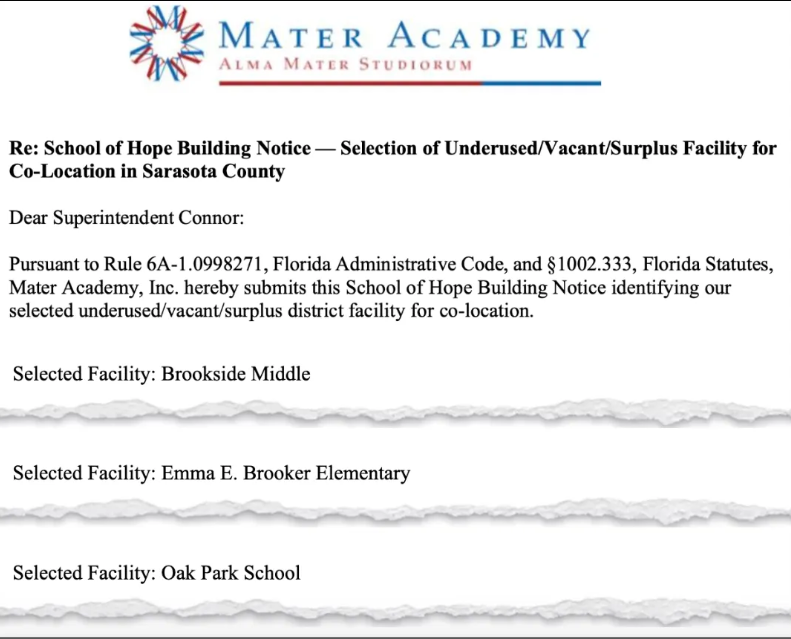
Co-Location Notice Sent, Photo Credit : Suncoast Searchlight
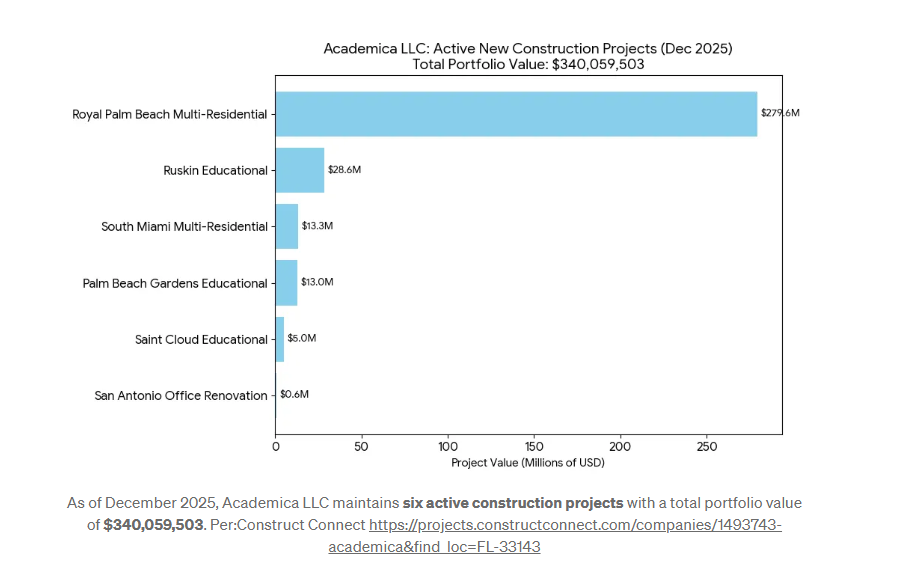
Mater Academy, a Miami-based charter giant managed by the for-profit Academica Corporation, had filed to “co-locate” inside Oak Park, Emma E. Booker Elementary, and Brookside Middle — three schools serving predominantly low-income, minority, and disabled students. Mater wasn’t coming to help. It was coming to claim “underutilized” space, rent-free, with the district forced to subsidize everything from buses to janitors to cafeterias.
Jennifer Ortiz stood in the pickup line clutching the notice, her face crumpling in the humid glare. “They’re not just taking space,” she told reporters, her voice cracking. “They’re taking my daughter Sofia’s future.” Sofia, 11, cerebral palsy tightening her limbs like wires, wheeled out that day beaming — unaware that her adaptive playground might soon host a charter’s recess chaos.
What unfolded in Sarasota wasn’t random bureaucratic chaos. It was the predictable endpoint of a 27-year scheme — one that began in Miami strip malls and now stretches across Florida like a shadow.
At its center: brothers Fernando and Ignacio Zulueta, the architects of Academica, a for-profit management company that has turned public education into a private ATM. Their protector? Florida Education Commissioner Manny Diaz Jr., a man who spent years on their payroll before overseeing the very system that now hands them the keys to public buildings.
This is the anatomy of a predatory takeover — not of failing schools, but of functioning ones targeted for their vulnerabilities. And thanks to a radical 2025 law, it’s just getting started.
Section I: Manufacturing Crisis, Harvesting Profit
Florida’s public schools aren’t failing by accident. They’re being methodically drowned.
Walk into any classroom across the state and you’ll find a tableau of managed decline: teachers pulling down a median salary of $51,000 — a figure that would embarrass a mid-level Applebee’s manager — personally bankrolling supplies that should be budget line items. Crayons. Pencils. Basic dignities. Meanwhile, the infrastructure crumbles around them. Roofs weep when it rains. Air-conditioning units labor and gasp like emphysema patients in August. Support staff, the invisible architecture holding schools upright, survive on $33,324 annually — poverty wages in a state where rent doesn’t care about your noble intentions.
The numbers tell a story of deliberate neglect. Per-pupil spending has contracted by $400 since 2019, even after adjusting for inflation’s steady grind. This isn’t happening in a state starved for revenue — Florida’s tax coffers have been robust, even flush. Yet in 2024, the Network for Public Education examined the wreckage and delivered a damning verdict: Florida ranked dead last among all fifty states plus D.C. in adequate school funding. Fifty-first out of fifty-one. The basement below the basement.
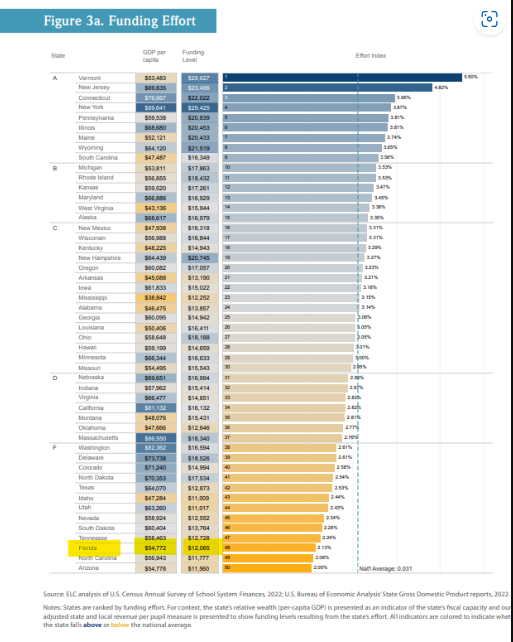
Funding Effort- Education Law Center
This starvation is policy, not accident. Lawmakers have perfected the art of misdirection, deploying culture-war pyrotechnics to obscure the wholesale abandonment of public education. In 2023, Governor Ron DeSantis signed House Bill 1557 into law, expanding what can only be described as regressive book bans under the sentimental guise of “protecting children” — a phrase that curdles when you consider that nearly five million Florida children live below the poverty line, and the legislation did precisely nothing to address that crisis.
By systematically limiting access to age-appropriate literature and historical materials, the state has achieved something perversely impressive: it meets the dictionary definition of indoctrination. Not the kind DeSantis claims to fight, but the textbook version — teaching a single, sanitized perspective while excluding others, foreclosing the very critical thinking that education is meant to cultivate.
The governor, naturally, staged his photo opportunities at overwhelmingly white, affluent charter schools, performing concern for “our children” while the majority of students — brown, Black, poor, traumatized — languished in classrooms that could double as object lessons in institutional abandonment.
At this writing, 47 percent of Florida’s children live in poverty. The teacher shortage has metastasized, particularly acute in special education. And then there’s literacy, where the crisis becomes generational. The research is unambiguous: children not reading at grade level by age eight face a dropout risk fifty times higher than their proficient peers, with consequences that compound across a lifetime. In 2025, more than 60 percent of Florida public school students read below grade level. In Sarasota and Manatee Counties, the figure hovers at 47 percent — communities still treading water, still falling behind.
Yet while public schools asphyxiate, public funds flow elsewhere. Charter schools, particularly the so-called Schools of Hope, market themselves as beacons of academic excellence, draped in the respectable garb of nonprofit status. It’s a shell game, an exercise in corporate obfuscation. Peel back the layers of intentionally Byzantine corporate entities — all established, owned, and operated by the same individuals — and the altruistic veneer dissolves. These “nonprofit” charter schools don’t just underperform academically; they’ve become synonymous with financial investigations, conflicts of interest, and faculty misconduct. The pattern is consistent enough to constitute a business model: extract public dollars, deliver private failures, rinse, repeat.
The architecture of the scheme is elegant in its cynicism. Starve public schools until they buckle. Declare them failures. Redirect funds to politically connected charter operators. Repeat until the public system is a husk, and education becomes one more market where profit, not outcomes, dictates winners and losers.

II. The Corporate Veil: A Russian Nesting Doll of Self-Dealing
To trace Mater Academy’s money is to descend into a deliberately constructed hall of mirrors — endlessly recursive, meticulously opaque, designed to confuse auditors and obscure accountability.
The Outermost Doll: Non-Profit Vessels
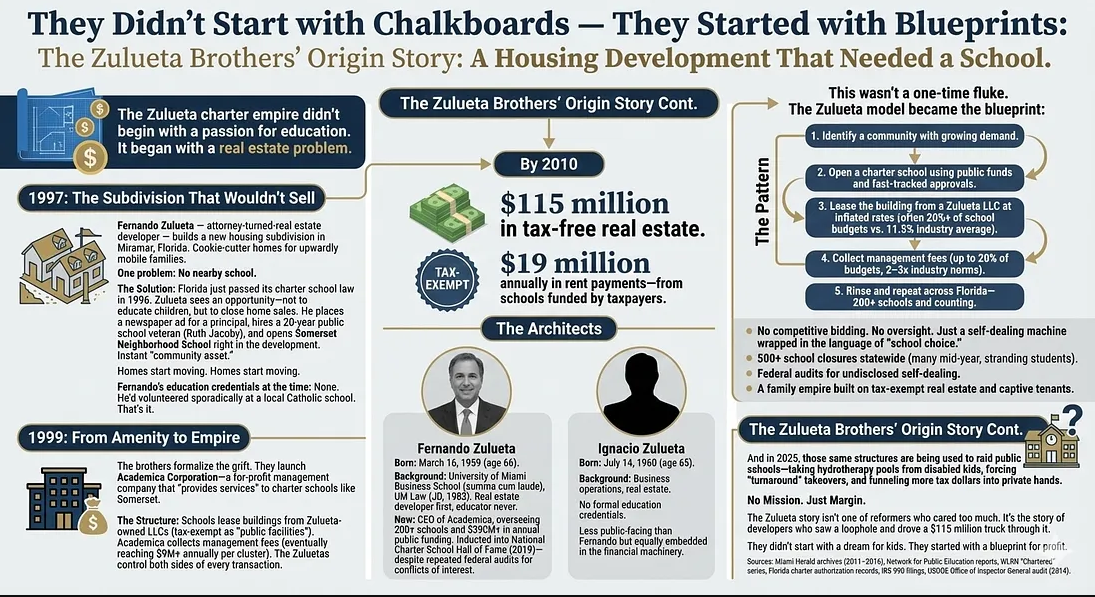
Public-facing entities like Mater Academy, Inc., Mater Academy Central, and Mater Foundation collect $390 million annually in taxpayer funds — state FEFP allocations, federal Title I grants, local property tax levies. Same interlocking board of directors. Same administrative offices. No real independence. These non-profits exist primarily as collection vehicles, funneling public dollars into the next layer.
The Middle Doll: For-Profit Management
Academica Corporation, owned and controlled by the Zulueta brothers, “manages” virtually everything for the charter schools — curriculum, hiring, facilities, vendor contracts — in exchange for management fees of 10–15% of operating budgets. These percentages dwarf industry standards and can exceed $9 million per school annually.
But it gets worse. Properties housing these publicly funded schools? They’re often leased from separate Zulueta-controlled LLCs at above-market rates determined through sweetheart deals with no competitive bidding. The brothers negotiate with themselves, set their own prices, and invoice their own schools.
The Innermost Doll: Real Estate Empire
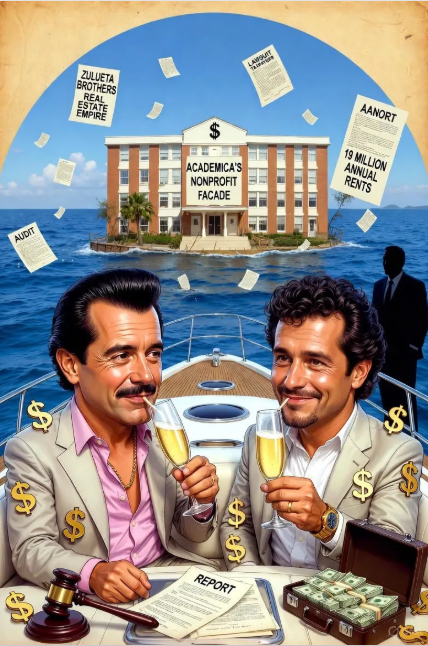
By 2010, the Zulueta brothers controlled an estimated $115 million in tax-exempt Florida real estate, generating approximately $19 million in annual rent. The scheme is elegantly simple: Buildings are purchased using tax-exempt public bonds issued on behalf of charter schools. Those same buildings are then leased back to the publicly funded schools at inflated rates. When properties appreciate or are sold, the capital gains flow to private LLCs — public financing, private profit.
The Smoking Gun: Doral College
The Doral College scandal remains the clearest proof of the system’s corruption. In 2011, Doral Academy Preparatory — a publicly funded charter school — extended a $400,000 “loan” to Doral College, a Zulueta-controlled for-profit institution where Manny Diaz Jr. served as Chief Operating Officer. The loan was never repaid. The fake dual-enrollment arrangement allowed Doral College to siphon additional state funds by claiming students were simultaneously enrolled. When investigators finally circled, the college lost its accreditation in 2017.
No one went to jail. No one was barred from receiving public funds. The empire simply reorganized and continued expanding.
“This is self-dealing at an almost incomprehensible scale,” says Jordan Mitchell, a forensic accountant who has analyzed charter financial structures for two decades. “They negotiate with themselves, set their own prices, and siphon public funds with absolute impunity. The oversight mechanisms that are supposed to prevent this simply don’t function.”
III. The Academica Fixer: Manny Diaz Jr. and the Inside Game
The Zulueta network’s expansion into vulnerable public schools is alarming on its own. But with Manny Diaz Jr. at the helm of Florida’s Department of Education, the stakes become existential: the very system meant to regulate charter operators is now overseen by a former insider.
On the surface, Diaz is polished, media-savvy, a former state senator and chair of the Republican Party of Florida. But a closer look reveals a troubling history.
In the 1990s, while teaching social studies at Hialeah-Miami Lakes Senior High, multiple students accused Diaz of inappropriate conduct. They described comments about female students’ appearances, casual discussions of drugs and clubbing, and flirtatious behavior that blurred professional lines.
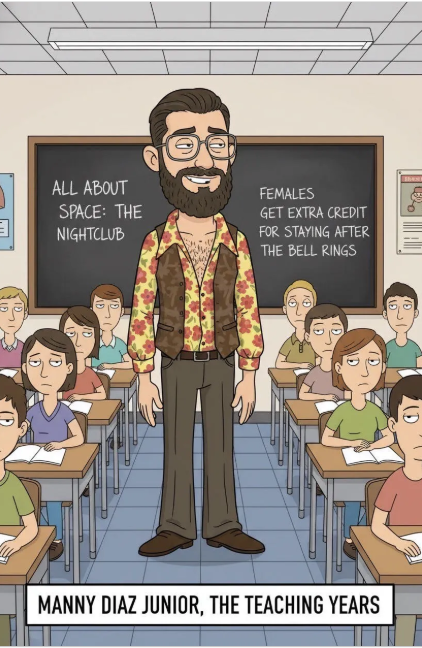
Alumni corroborated these claims, and the Miami Herald documented the accounts. One former student tweeted Diaz was a “pervert and inappropriate teacher,” recalling open discussions of ecstasy use at Miami clubs. Another said, “He was always flirting with the girls and trying to be the popular teacher. Everything she said about him is true, all the partying.” Neyda Borges, a 1999 graduate, described him as a “cool” teacher in a culture of “really weird behavior,” joking with male students about clubs while making suggestive comments about girls — normalizing inappropriate conduct.
From 2009 to 2013, Diaz stepped into the corporate side of education, serving as Chief Operating Officer of Doral College, a for-profit institution controlled by the Zulueta brothers’ Academica network. During his tenure, Doral College accepted a $400,000 loan from Doral Academy Preparatory — a publicly funded charter school managed by Academica.
The arrangement, investigators later concluded, was a glaring conflict of interest and misuse of taxpayer funds. By 2017, Doral College had lost accreditation and shuttered, leaving students with degrees of questionable value. Diaz had already moved on, first to legislative roles, then to statewide office — continuing to champion policies that enriched his former colleagues.
Public records show that as a legislator, Diaz repeatedly sponsored bills expanding charter access, reducing district oversight, and loosening financial reporting requirements. Campaign contributions flowed from charter-affiliated entities, including Academica itself.
In 2022, Governor Ron DeSantis appointed Diaz Commissioner of Education, granting him authority over the very programs and facilities that once lined his pockets. He now approves charter applications, greenlights co-locations, and oversees billions in education funding — including the Schools of Hope program that enabled the Zulueta network’s co-location raids in Sarasota.
Ethics experts are blunt.
“You have the state’s top education official, the referee, who used to work for one of the players,” says Alicia Summers, former federal prosecutor and government ethics professor. “Even if he recuses himself, the structure itself undermines public trust.”
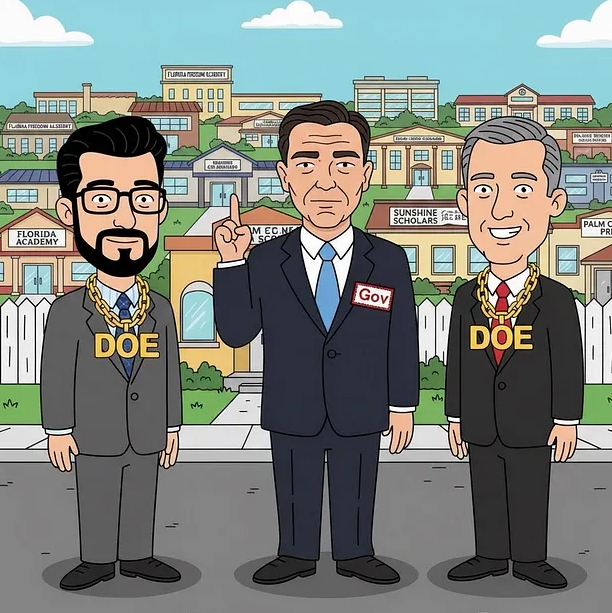
Diaz’s office declined comment. The Department of Education insists he “has no financial interest in any charter operator” and that decisions are guided by law and student outcomes. But families whose children attend targeted schools see a different picture. The man entrusted with safeguarding Florida’s public education system is the very insider who helped build the empire now threatening their schools.
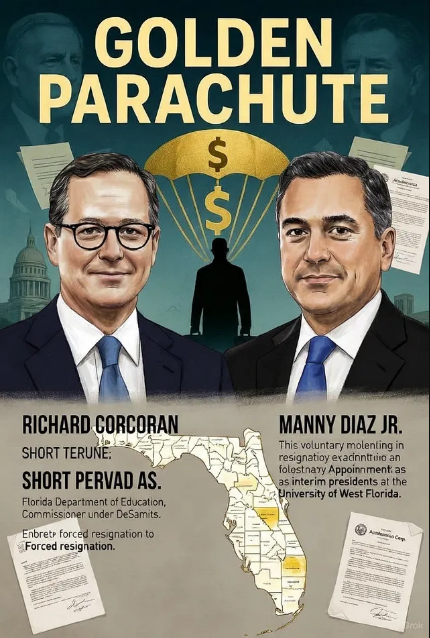
By 2025, Diaz had added yet another title — interim president of the University of West Florida — drawing a second six-figure salary while steering statewide education policy. When Sarasota parents rallied against the co-location of Oak Park, Diaz’s response was measured and clinical: co-location “expands opportunity” and “increases parental choice.”
Parents heard something else entirely: hostage-taking dressed as reform.
IV. The Legal Cudgel: SB 2510 and the Gutting of Safeguards
The weapon that enabled Sarasota’s crisis didn’t exist two years ago.
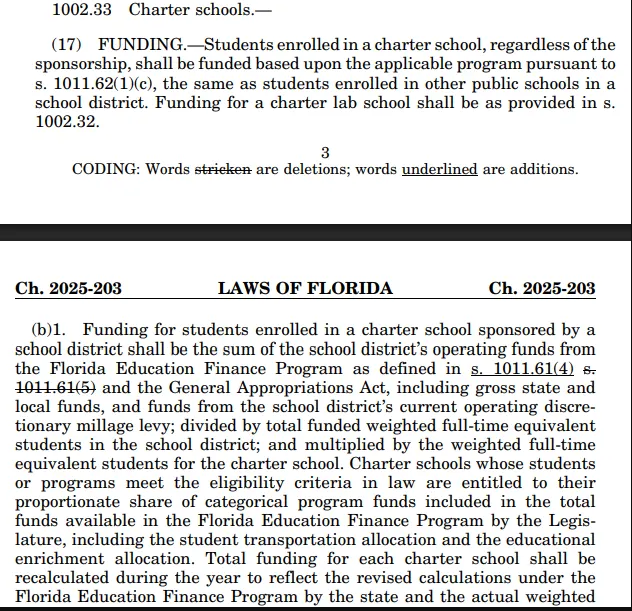
In spring 2025, the Florida Legislature passed Senate Bill 2510 — a sprawling 387-page omnibus bill that revived and radicalized the 2017 “Schools of Hope” program. Originally conceived as a targeted intervention for chronically failing schools in deeply distressed communities, SB 2510 broadened eligibility thresholds, loosened performance criteria, and handed charter operators a statutory right to co-locate inside “underutilized” public facilities.
The law’s requirements are brutally one-sided. School districts must provide space, transportation, food service, and custodial support to co-locating charters. Districts get just 20 days to prove “material impracticability” — an almost impossible evidentiary burden requiring documentation that the charter’s presence would cause immediate physical danger or render the building structurally unsound. No local referendum. No meaningful public input process. No real avenue for appeal.
“This isn’t collaboration,” says Rebecca Beltran, former general counsel for a large Florida school district, her voice like gravel. “This is a legal hammer disguised as policy. It turns what should be negotiation into mandate, transforming co-location from partnership into forced occupation.”
The financial mathematics are devastating. Per-pupil funding flees with students who transfer to the co-located charter, but the district continues eating maintenance costs, utilities, insurance, and infrastructure expenses for the entire building. Charters get subsidized palaces while the host district bleeds resources.
In Sarasota, Mater Academy’s October 2025 filings strategically targeted schools operating at 43–58% capacity — a figure that ignored crucial context. Oak Park’s “empty” rooms aren’t vacant classrooms waiting to be filled.
They’re specialized therapy suites, sensory integration spaces, medical treatment areas, and equipment storage for devices that keep children alive. Booker Elementary’s “underutilization” reflected smaller class sizes necessary for students living in profound poverty and trauma. Brookside’s numbers ignored the reality that middle schoolers need science labs, art rooms, and band practice spaces that sit empty during certain periods.
By November 8, 2025, Sarasota’s school board voted in emergency session to frantically reorganize school assignments and redraw attendance boundaries, artificially hiking capacity numbers in a desperate bid to barricade the doors against Mater’s invasion. They were partially successful — but only through bureaucratic contortions that disrupted educational continuity for thousands of students.
Too late for some districts. Orange County, Hillsborough County, and others brace for similar raids. In Polk County, eight public schools were put on notice by Mater Academy just last month, watching Sarasota’s playbook unfold as charter operators sharpen their legal briefs.
V. The Targets: Vulnerability, Not Failure
Mater Academy didn’t pick failing schools. It didn’t target institutions collapsing under mismanagement or academic disaster. It picked the powerless — schools serving communities with the least political clout, the fewest resources to fight back, and the most profound needs.
Emma E. Booker Elementary sits on Sarasota’s north side, a neighborhood school where 94% of students are economically disadvantaged and 87% are students of color. Named for a pioneering Black educator who taught during segregation, the school stands as a symbol of resilience in its community.
By the Florida Department of Education’s own metrics, it is a success story: consistent A and B grades, math and reading gains that exceed expectations, and a faculty that, despite chronic under-resourcing, meets profound challenges with unwavering dedication. Teachers arrive before dawn and stay past dusk, running food pantries and clothing closets out of their own classrooms, knowing which children slept in cars, went hungry, or fled domestic violence the night before. This is the school Mater Academy now deems ripe for takeover.
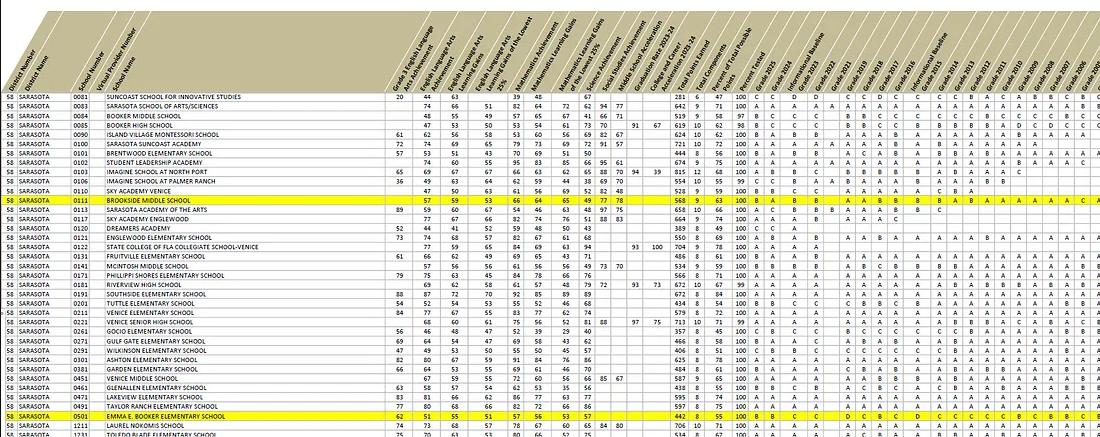
From Florida Dept. Of Educations, Florida School Accountability Reports- School Grades 2025
Brookside Middle School
Brookside Middle School, built in 1955, stands as a cornerstone of its community — a steadfast presence for nearly seventy years. Sixty-five percent of its students come from economically disadvantaged households, and more than half are students of color. Yet year after year, Brookside maintains steady A and B grades, defying the odds that statistics often predict.
Teachers here coach basketball in donated shoes. The band director quietly pays out of pocket to repair worn instruments. Students arrive each day carrying more than just textbooks — their backpacks weighted with the invisible burdens of financial strain, family trauma, and language barriers.
They are also navigating one of the most turbulent stages of human development: early adolescence. Between the ages of 11 and 14, the brain undergoes a profound restructuring that shapes emotional regulation, identity, and social awareness. It is during this period — second only to early childhood in developmental significance — that young people shift from family-centered to peer-centered worlds. They become acutely sensitive to social cues, deeply aware of belonging, and vulnerable to the highs and lows of self-discovery. The relationships and experiences formed in these years leave lasting imprints on who they will become.
And through it all, Brookside’s teachers stretch themselves to meet every need — academic, emotional, and human.
Yet despite its success, Brookside now finds itself in the crosshairs of a predatory charter network — not because it has failed, but precisely because it has succeeded in serving a vulnerable communit
No crisis here — except the one about to be manufactured.
Oak Park School
Oak Park School is Sarasota County’s only public K–12 school for children with profound, complex disabilities. 64% of students are economically disadvantaged, 45% are students of color, yet here, progress doesn’t show up on standardized tests. It sounds like a child’s first laugh through a speaking valve. It looks like three unassisted steps after two years of daily physical therapy. It feels like a mother weeping with joy because her son with traumatic brain injury finally recognized her face.
The spaces Mater coveted are far from empty: a hydrotherapy pool where children with spina bifida build strength without gravity crushing their spines; sensory integration rooms where children with severe autism learn to tolerate clothing textures; medical treatment areas where nurses suction tracheostomy tubes and monitor feeding pumps; and storage for Hoyer lifts, adapted bicycles, communication devices, and the unglamorous apparatus that makes life possible. These rooms are lifelines, not luxuries, yet Mater Academy has marked them as “underutilized,” threatening to disrupt the fragile miracle these children rely on.
In Sarasota County, families raising children with intellectual, developmental, or physical disabilities face an unforgiving reality: limited support in public schools, or exorbitant private tuition and travel for specialized services.
More than 8,000 of the county’s roughly 45,000 K–12 students — about 18 percent — have identified disabilities. Yet no tuition-free public school exists that serves them exclusively. Children with complex needs are placed in mainstream classrooms, often without adequate staffing, resources, or therapeutic programs.
Private special education schools are available, but tuition frequently tops $18,000 per year. When combined with insurance costs, medical expenses, and ongoing appointments, a family could spend nearly $234,000 to provide a full K–12 education — a financial barrier few can overcome.
Amid these challenges, Oak Park School stands alone. The only public school within sixty miles dedicated entirely to students with disabilities, it serves more than 225 children, offering the specialized education and therapy they need — services otherwise out of reach for most families.
“These schools demonstrate extraordinary resilience in the face of systemic neglect,” says Maria Torres, a longtime education advocate, her eyes blazing. “Targeting schools that serve predominantly Black, brown, and disabled children isn’t a bug in this system. It’s the feature. It’s the entire point.”
VI. The Playbook: A National Template
What’s unfolding in Florida isn’t unique. It’s a refined playbook that’s been tested, iterated, and exported to vulnerable districts across America:
Starve public schools. through legislative budget cuts and funding diversions, creating the appearance of failure.
Label schools as failing. using manipulated metrics that ignore poverty, disability, and trauma while rewarding schools that exclude challenging students.
Rewrite laws. through lobbying and campaign contributions, lowering barriers for charter takeovers and co-location mandates (see: SB 2510).
Build opaque corporate nests. using interlocking non-profits, for-profit management companies, and real estate LLCs that obscure money flows and accountability.
Install political protectors. in oversight positions — ideally people who previously worked for the charter operators and owe their careers to the network.
Target vulnerable districts. serving poor, minority, and disabled students with the least political power to resist.
Cream students. by selectively enrolling higher-performers and pushing out expensive, challenging cases, then tout superior test scores as proof of excellence.
Rinse and repeat. — Detroit, New Orleans, Los Angeles, Philadelphia, and now Florida. The lab rat today becomes America’s blueprint tomorrow.
VII. The Accountability Gap and the Performance Paradox
The fundamental asymmetry in Florida’s education system isn’t about quality. It’s about accountability.
Public schools operate in crystal-clear fishbowls. Budgets are published line by line. Teacher certifications are verified. School board meetings are public, recorded, and archived. Elected board members can be voted out. Principals answer to superintendents who answer to communities. Every decision is subject to sunshine laws, open records requests, and public scrutiny.
Charter schools operate in shadows. Management contracts are proprietary. Vendor relationships are opaque. Board members are hand-picked by management companies, not elected by communities. Financial statements are filed months late, often missing crucial details about related-party transactions. When scandals break, charters simply close and reopen under new names with the same operators. Teachers aren’t required to hold state certifications. Discipline data goes unreported. Special education students are counseled out or never enrolled in the first place.
The performance paradox is simple: Charter schools can only appear superior if they don’t serve everyone. Cream the highest performers. Avoid students with expensive disabilities. Push out behavioral challenges. Counsel struggling learners back to public schools. Then compare your test scores to institutions serving all comers and declare victory.
“Your model only looks successful if mine is forced to take every child you reject,” says Akil Bello, a nationally recognized testing and accountability expert. “That’s not competition. It’s a rigged game.”
When public schools are forced to accept every student — every child in a wheelchair, every teenager fleeing gang violence, every immigrant who arrived last week speaking no English, every kid with a $90,000-per-year medical care plan — and then punished for not matching the test scores of schools that avoid those same students, the system isn’t measuring quality. It’s manufacturing justification for privatization.
Epilogue: The Ironic Coda of “Hope”
Florida ranks 50th in teacher pay and dead last in school funding adequacy. Yet DeSantis and Diaz Jr.’s “Schools of Hope” promises salvation through operators who’ve profited from exclusion and self-dealing for 27 years.
In Sarasota, parents continue to rally outside school board meetings, voices hoarse from chanting. Lawyers circle, preparing civil rights complaints and facilities challenges. Districts frantically redraw boundaries and reorganize schools in bureaucratic guerrilla warfare against state mandates. The veil trembles, catching light, threatening to tear.
But the Russian nesting dolls keep spinning. The $400,000 ghost loan. The $9 million annual management fees. The $115 million real estate empire built on tax-exempt bonds. The brother architects counting money in Miami while children in Sarasota wonder if their therapy rooms will survive.
The veil can be torn. It requires courage, but the tools exist:
Follow the money. Demand line-item accounting for every management fee, every lease payment, every related-party transaction. Force charter operators to publish financials with the same transparency required of public schools.
Expose the protectors. Name the politicians who take charter PAC money and then vote to gut public school funding. Trace the career paths of commissioners who worked for the very operators they now regulate. Conflict of interest isn’t a technicality — it’s corruption with a bureaucratic mask.
Amplify the vulnerable. Center the voices of parents like Jennifer Ortiz, teachers like Marianne Foster, students like Sofia. These aren’t abstract policy debates. They’re children whose futures hang in the balance.
Organize relentlessly. Sarasota’s parents forced their school board to act through sheer sustained pressure. That model works. Pack meetings. Flood inboxes. Make opposition louder than compliance.
Demand legislative accountability. SB 2510 can be amended or repealed. Politicians respond to pressure, especially in election years. Make charter profiteering a campaign liability.
Return public education to its purpose: Serving all children, especially the most vulnerable, not generating returns for connected insiders and real estate moguls.
Because for kids like Sofia Ortiz — who wheeled out of Oak Park that September afternoon beaming with the innocent joy of a child unaware that adults are fighting over her future — hope isn’t a slogan. Hope isn’t a brand. Hope isn’t a legislative gimmick designed to transfer wealth.
Hope is a hallway wide enough for a wheelchair and dreams big enough to imagine a future where every child, regardless of disability, race, or zip code, gets the education they deserve.
That’s a future worth fighting for.
And the first step is tearing down the veil.
Christy Chilton, Spotlight Sarasota
METHODOLOGY/SOURCES
This investigation draws on a comprehensive review of public records, legislative documents, news reporting, academic research, and advocacy materials spanning nearly three decades of Florida charter school policy and operations.¹ ² ³ ⁴ ⁵ ⁶ ⁷ ⁸ ⁹ ¹⁰ ¹¹ ¹² ¹³ ¹⁴ ¹⁵ ¹⁶ ¹⁷ ¹⁸ ¹⁹ ²⁰ ²¹ ²² ²³ ²⁴ ²⁵ ²⁶ ²⁷ ²⁸ ²⁹ ³⁰ ³¹ ³² ³³ ³⁴ ³⁵ ³⁶ ³⁷ ³⁸ ³⁹ ⁴⁰ ⁴¹ ⁴² ⁴³ ⁴⁴ ⁴⁵ ⁴⁶ ⁴⁷ ⁴⁸ ⁴⁹ ⁵⁰ ⁵¹ ⁵² ⁵³ ⁵⁴ ⁵⁵ ⁵⁶ ⁵⁷ ⁵⁸ ⁵⁹ ⁶⁰ ⁶¹ ⁶² ⁶³ ⁶⁴
¹ WLRN. (n.d.). Charter schools of hope expand in Florida. WLRN. https://chartered.wlrn.org/charter-schools-hope-expand-florida/
² Meckler, L. (2025, October 17). In Florida, a new law lets charters move onto public school campuses. The Washington Post. https://www.washingtonpost.com/education/2025/10/17/charter-schools-florida/
³ Fox 13 News Staff. (2025, October 9). Charter school operators preparing to potentially move onto public school campuses under recently adopted state guidelines. FOX 13 News. https://www.fox13news.com/news/charter-school-operators-preparing-potentially-move-onto-public-school-campuses-under-recently-adopted-state-guidelines
⁴ Suncoast Searchlight. (2025, October 10). Charter schools of hope in Sarasota could occupy Mater Academy campus. Suncoast Searchlight. https://suncoastsearchlight.org/charter-schools-hope-sarasota-occupy-mater/
⁵ Marlowe, J. (2025, October 9). Charter operators seek to move into Florida public schools under new law. Tampa Bay Times. https://www.tampabay.com/news/education/2025/10/09/charter-operators-seek-move-into-florida-public-schools-under-new-law/
⁶ Florida Politics. (2025, October 29). Darryl Rouson moves to pull plug on ‘Schools of Hope’ colocation rule as public schools brace for takeovers. Florida Politics. https://floridapolitics.com/archives/764933-darryl-rouson-moves-to-pull-plug-on-schools-of-hope-colocation-rule-as-public-schools-brace-for-takeovers/
⁷ WUSF. (2025, October 20). Sarasota superintendent talks ‘Schools of Hope’ program, charter schools. WUSF. https://www.wusf.org/the-florida-roundup/2025-10-20/sarasota-superintendent-talks-schools-of-hope-program-charter-schools
⁸ FOX 13 News Staff. (2025, October 31). Pinellas County lawmaker looks to repeal policy on charter schools sharing space on public campuses. FOX 13 News. https://www.fox13news.com/news/pinellas-county-lawmaker-repeal-policy-charter-schools-share-space-public-campuses
\ ⁹ Florida Legislature. (n.d.). The 2023 Florida Statutes. Online Sunshine. https://www.leg.state.fl.us/Statutes/index.cfm?App_mode=Display_Statute&URL=1000-1099%2F1002%2FSections%2F1002.33.html
¹⁰ MGT Consulting Group. (2022, June 30). Florida Department of Education Office of Inspector General Operational Audit. Florida Department of Education. https://ppl-ai-file-upload.s3.amazonaws.com/web/direct-files/attachments/135380888/e975d5a3-8fe7-47b5-9734-943b2a98877e/Full.pdf
¹¹ K12 Dive. (2014, April 22). Federal authorities investigating Academica. K12 Dive. https://www.k12dive.com/news/federal-authorities-investigating-academica/253450/
¹² CBS News Miami. (2024, July 26). North Miami school maintenance worker arrested for inappropriate comments to 15-year-old student, authorities say. CBS News. https://www.cbsnews.com/miami/news/north-miami-school-maintenance-worker-arrested-for-inappropriate-comments-to-15-year-old-student-authorities-say/
¹³ WJCT News. (2014, April 22). Feds investigating Florida’s largest charter school management firm. WJCT. https://news.wjct.org/law-order/2014-04-22/feds-investigating-floridas-largest-charter-school-management-firm
¹⁴ Daily Kos. (2011, December 15). Charter schools cozy relationships, little oversight, taxpayer-paid profits. Daily Kos. https://www.dailykos.com/stories/2011/12/15/1045633/-
¹⁵ Ricks, R. (2024, September 6). Florida’s “Schools of Hope” legislation. Rebekah Ricks. https://rebekahricks.substack.com/p/floridas-schools-of-hope-legislation
¹⁶ Suncoast Searchlight. (2025, October 22). ‘Over my dead body’: Manatee schools prepare to battle charter takeover plans. Suncoast Searchlight. https://suncoastsearchlight.org/over-my-dead-body-manatee-schools-prepare-to-battle-charter-takeover-plans/
¹⁷ Burris, C. (2019, July 1). Who is Ferdinand Zulueta? Diane Ravitch’s blog. https://dianeravitch.net/2019/07/01/carol-burris-who-is-ferdinand-zulueta/
¹⁸ Bill Analysis and Fiscal Impact Statement. (2025, March 27). The Florida Senate. https://www.flsenate.gov/Session/Bill/2025/2510/Analyses/s2510z2.BUC.PDF
¹⁹ Tampa Bay Times. (2011, December 14). Charter schools cozy relationships, little oversight, taxpayer-paid profits. Tampa Bay Times. https://www.tampabay.com/archive/2011/12/14/charter-schools-cozy-relationships-little-oversight-taxpayer-paid-profits/
²⁰ Florida Department of Education. (n.d.). Charter school FAQs. Florida Department of Education. https://flcharterschool.org/charter-school-faqs/
²¹ Business Observer. (2025, October 17). Charter school operator preps for major expansion. Business Observer. https://www.businessobserverfl.com/news/2025/oct/17/charter-school-operator-major-expansion/
²² Florida Department of Education. (n.d.). Audit reporting products. Florida Department of Education. https://www.fldoe.org/about-us/office-of-the-inspector-general/audit-reporting-products.stml
²³ U.S. Department of Education. (2020, October). S282A200017 — Florida Department of Education. U.S. Department of Education. https://www.ed.gov/sites/ed/files/2020/10/S282A200017-Florida-Department-of-Education.pdf
²⁴ Observatory. (n.d.). Financial fraud, malfeasance, and ineptitude plague federal government charter schools program. Observatory. https://observatory.wiki/Financial_Fraud,_Malfeasance,_and_Ineptitude_Plague_Federal_Government_Charter_Schools_Program
²⁵ The Florida Times-Union. (2018, November 14). Former Duval charter school operator gets 20 years for fraud. Jacksonville.com. https://www.jacksonville.com/story/news/2018/11/14/former-duval-charter-school-operator-gets-20-years-for-fraud/8380098007/
²⁶ Sarasota County Schools. (n.d.). Oak Park School. Sarasota County Schools. https://www.sarasotacountyschools.net/o/oakpark
²⁷ Civil Rights Project. (2016, March). Charter schools, civil rights, and school discipline: A comprehensive review. UCLA Civil Rights Project. https://civilrightsproject.ucla.edu/reports/charter-schools-civil-rights-and-school-discipline-a-comprehensive-review/
²⁸ Ricks, R. (2023, January 10). DeSantis taps state senator with charter school ties to replace Corcoran. Rick’s Blog. https://ricksblog.biz/desantis-taps-state-senator-with-charter-school-ties-to-replace-corcoran/ ²⁹ Losen, D., et al. (2016, March). Charter schools, civil rights, and school discipline: A comprehensive review. UCLA Civil Rights Project. https://civilrightsproject.ucla.edu/wp-content/uploads/2016/03/losen-et-al-charter-school-discipline-summary-2016.pdf ³⁰ The Florida Times-Union. (2022, April 21). Sen. Manny Diaz selected as Florida’s new education commissioner. Jacksonville.com. https://www.jacksonville.com/story/news/politics/state/2022/04/21/sen-manny-diaz-selected-floridas-new-education-commissioner/7403087001/ ³¹ WTXL. (2018, September 20). Report: Growing charter school system is wasteful for taxpayers, gives more money per student. WTXL. https://www.wtxl.com/news/report-growing-charter-school-system-is-wasteful-for-taxpayers-gives/article_c33c8688-bc4a-11e8-a1fa-fba48a8d4507.html ³² Legg, S. M. (2017, May 10). Will Erik Fresen go to jail? Is charter corruption in Florida out of control? Diane Ravitch’s blog. https://dianeravitch.net/2017/05/10/sue-m-legg-will-erik-fresen-go-to-jail-is-charter-corruption-in-florida-out-of-control/ ³³ Ravitch, D. (2025, November 5). Florida: Imprisoned charter school owner seeks to reduce repayments to district he cheated. Diane Ravitch’s blog. https://dianeravitch.net/2025/11/05/florida-imprisoned-chsrter-school-owner-seeks-to-reduce-repayments-to-district-he-cheated/ ³⁴ Florida Democratic Party. (2024, May). ICYMI: Under Republican leadership, Florida is 50th in the nation in teacher pay and has a crippling teacher shortage. Florida Democratic Party. https://floridadems.org/2024/05/icymi-under-republican-leadership-florida-is-50th-in-the-nation-in-teacher-pay-and-has-a-crippling-teacher-shortage/ ³⁵ National Center for the Study of Privatization in Education. (2007, March). Charter school funding: Inequity persists. Teachers College, Columbia University. https://ncspe.tc.columbia.edu/working-papers/files/OP214.pdf ³⁶ Fund Education Now. (2024, July 9). Who’s Ralph Arza? Why should school board members, candidates & voters be concerned? Fund Education Now. https://fundeducationnow.org/whos-ralph-arza-why-should-school-board-members-candidates-voters-be-concerned/ ³⁷ WLRN. (2024, April 3). Broward charter schools in context with Manny Diaz Jr. WLRN. https://www.wlrn.org/education/2024-04-03/broward-charter-schools-context-manny-diaz-jr ³⁸ WUSF. (2024, June 11). DeSantis vows to increase funding for teacher pay; educator unions say it’s not enough. WUSF. https://www.wusf.org/education/2024-06-11/desantis-vows-increase-funding-teacher-pay-educator-unions-say-not-enough ³⁹ Florida Education Association. (2023, September 18). Florida education leaders discuss teacher pay. Florida Education Association. https://feaweb.org/release/florida-education-leaders-discuss-teacher-pay/ ⁴⁰ WMNF. (2025, March 14). Florida lawmakers pass charter school expansion bill. WMNF. https://www.wmnf.org/florida-lawmakers-pass-charter-school-expansion-bill/ ⁴¹ WUSF. (2025, October 13). District leaders speak out after public schools targeted for charter takeover letters. WUSF. https://www.wusf.org/education/2025-10-13/district-leaders-speak-out-public-schools-targeted-charter-takeover-letters ⁴² Project 10. (n.d.). District promise program. Project 10. http://project10.info/DetailPageDistrictPromise.php?MainPageID=46 ⁴³ School Stories. (2012, May 17). Pushed out: Charter schools contribute to the city’s growing suspension rates. School Stories. http://school-stories.org/2012/05/pushed-out-charter-schools-contribute-to-the-citys-growing-suspension-rates/ ⁴⁴ Action Network. (n.d.). Calling on Gov. DeSantis to remove Florida’s Commissioner of Education Manny Diaz Jr. Action Network. https://actionnetwork.org/petitions/calling-on-gov-desantis-to-remove-floridas-commissioner-of-education-manny-diaz-jr/ ⁴⁵ Fun 4 Manatee Kids. (n.d.). Oak Park School. Fun 4 Manatee Kids. https://fun4manasotakids.com/Education-Childcare/Special-Needs-Schools/Oak-Park-School/View-details ⁴⁶ Yourself. (2017, May 18). Things didn’t go well when Betsy DeVos was confronted with her department’s charter school fraud. YouTube. https://www.youtube.com/watch?v=zSlhsPneTjs ⁴⁷ EdPolitics. (2017, May 18). Things didn’t go well when Betsy DeVos was confronted with her department’s charter school fraud. EdPolitics. https://edpolitics.org/things-didnt-go-well-when-betsy-devos-was-confronted-with-her-departments-charter-school-fraud/ ⁴⁸ Caritas Law Group. (n.d.). Tax-exempt bond financing. Caritas Law Group. https://caritaslawgroup.com/practice-areas/tax-exempt-bond-financing/ ⁴⁹ Salon. (2019, April 23). Things didn’t go well when Betsy DeVos was confronted with her department’s charter school fraud. Salon. https://www.salon.com/2019/04/23/things-didnt-go-well-when-betsy-devos-was-confronted-with-her-departments-charter-school-fraud_partner/ ⁵⁰ Burris, C. (2023, January). Chartered for profit: The hidden world of charter schools operative for Wall Street. Network for Public Education. https://dianeravitch.net/wp-content/uploads/2023/01/chartered-for-profit-2.pdf ⁵¹ National Alliance for Public Charter Schools. (2025, March). Tax-exempt private activity bonds. National Alliance for Public Charter Schools. https://publiccharters.org/wp-content/uploads/2025/03/Tax-Exempt-Private-Activity-Bonds-One-Pager-1.pdf ⁵² Florida Policy Institute. (2023, August 21). Fully fund Florida’s K-12 public schools. Florida Policy Institute. https://www.floridapolicy.org/initiatives/fully-fund-floridas-k-12-public-schools ⁵³ Urban Institute. (2021, April 8). Has the increase in charter schools decreased school segregation or made it worse? Housing Matters. https://housingmatters.urban.org/articles/has-increase-charter-schools-decreased-school-segregation-or-made-it-worse ⁵⁴ Collins, C., & Osman, H. (2022, July 5). Adequacy and equity in capital funding for Florida’s public schools. Florida State University. https://cosspp.fsu.edu/collins/wp-content/uploads/sites/28/2022/08/FINAL-Adequacy-and-Equity-in-Capital-Funding-for-Floridas-Public-Schools-7-5-2022.pdf ⁵⁵ National Education Association. (2023, May 15). Racial isolation of charter school students exacerbating resegregation. NEA Today. https://www.nea.org/nea-today/all-news-articles/racial-isolation-charter-school-students-exacerbating-resegregation ⁵⁶ Florida Department of Education. (2024, July). 2024–25 FEFP district summary. Florida Department of Education. https://www.fldoe.org/file/7507/Fefpdist.pdf ⁵⁷ FOX 13 News Staff. (2023, April 26). Map: Florida ranks 2nd worst in nation for teacher pay, NEA report finds. FOX 13 News. https://www.fox13news.com/news/map-florida-ranks-2nd-worst-nation-teacher-pay-nea-report-finds ⁵⁸ Sarasota County Schools. (n.d.). Oak Park School. Sarasota County Schools. https://www.sarasotacountyschools.net/oakpark ⁵⁹ WLRN. (n.d.). Charter schools of hope expand in Florida. WLRN. https://chartered.wlrn.org/charter-schools-hope-expand-florida/ ⁶⁰ Meckler, L. (2025, October 17). In Florida, a new law lets charters move onto public school campuses. The Washington Post. https://www.washingtonpost.com/education/2025/10/17/charter-schools-florida/ ⁶¹ Fox 13 News Staff. (2025, October 9). Charter school operators preparing to potentially move onto public school campuses under recently adopted state guidelines. FOX 13 News. https://www.fox13news.com/news/charter-school-operators-preparing-potentially-move-onto-public-school-campuses-under-recently-adopted-state-guidelines ⁶² Suncoast Searchlight. (2025, October 10). Charter schools of hope in Sarasota could occupy Mater Academy campus. Suncoast Searchlight. https://suncoastsearchlight.org/charter-schools-hope-sarasota-occupy-mater/ ⁶³ Bill Analysis and Fiscal Impact Statement. (2025, March 27). The Florida Senate. https://www.flsenate.gov/Session/Bill/2025/2510/Analyses/s2510z2.BUC.PDF ⁶⁴ Ricks, R. (2024, September 6). Florida’s “Schools of Hope” legislation. Rebekah Ricks. https://rebekahricks.substack.com/p/floridas-schools-of-hope-legislation