Sister Rosetta Tharpe: The Woman Who Electrified Rock Before Rock Had a Name
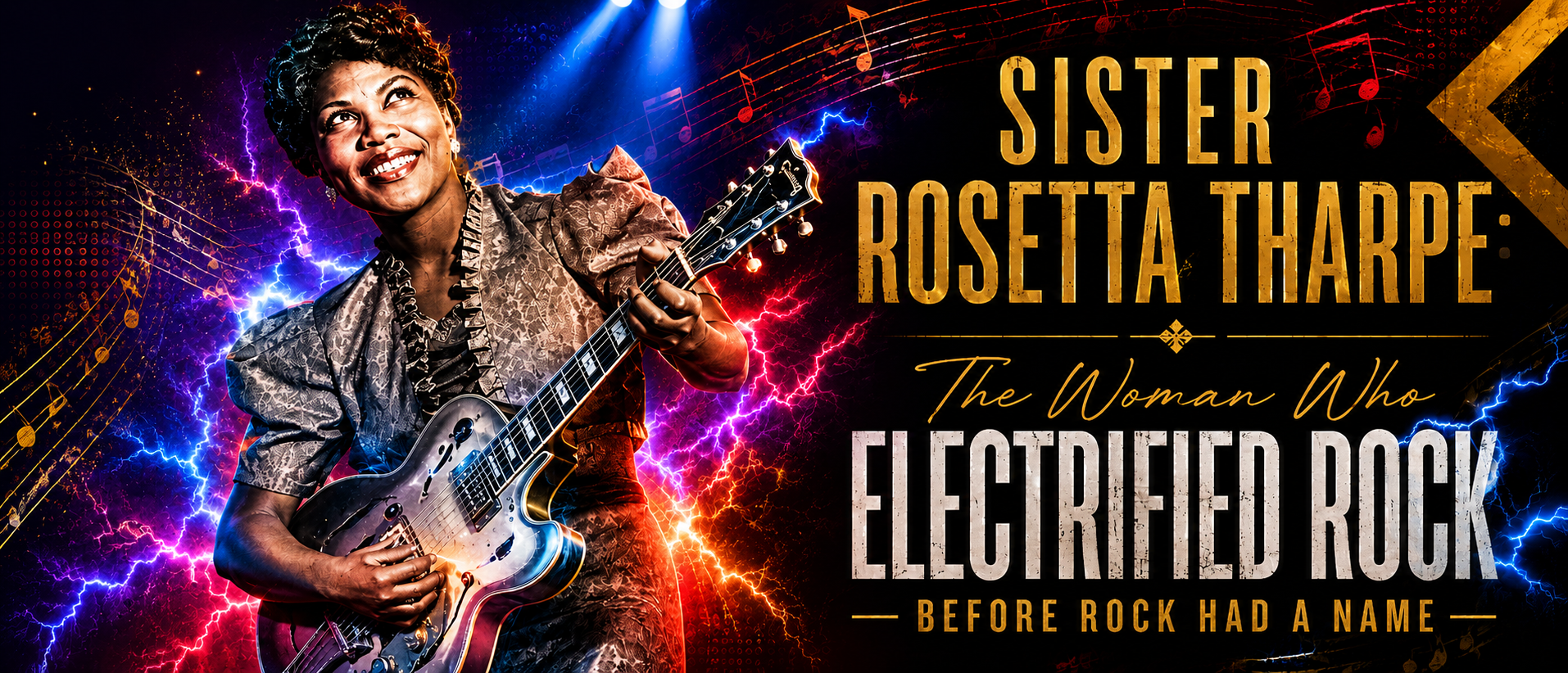
In the pantheon of music legends, Sister Rosetta Tharpe stands as a revolutionary force—an artist whose influence on rock and roll is as profound as it is too often overlooked.
Decades before distorted guitars became synonymous with rebellion, Tharpe was wielding one with gospel fire and unmistakable swagger. Her fusion of sacred music, urban blues, rhythmic intensity, and electrifying guitar work during the 1930s and 1940s helped establish the foundation upon which rock and roll would be built.
Known today as the “Godmother of Rock and Roll,” Tharpe did more than anticipate the genre. She embodied it.
A trailblazer in every sense, she defied the boundaries imposed upon her by race, gender, religion, and social convention. She commanded stages with virtuosity, charisma, and a physical confidence rarely afforded to Black women in the public eye. Sister Rosetta Tharpe did not simply play the guitar—she attacked it, transformed it, and made it speak.
Long before rock had a name, she was already playing it.
Early Life and Career
Rosetta Nubin was born on March 20, 1915, in Cotton Plant, Arkansas, into a world shaped by poverty, segregation, faith, and music. Her family, like many Black families in the rural South, survived by picking cotton for white landowners while living under the oppressive realities of Jim Crow.
Her mother, Katie Bell Nubin, was a devout gospel singer, preacher, and member of the Church of God in Christ, a Pentecostal denomination in which music was central to worship. Within that environment, young Rosetta’s remarkable talent emerged almost immediately.
By the age of six, she was already singing and playing guitar alongside her mother. Together, they traveled as a mother-and-daughter gospel act, combining sermons with musical performances. Rosetta was soon promoted as “The Guitar-Playing Miracle,” a title that reflected both her youth and her extraordinary command of an instrument rarely associated with girls—particularly Black girls—at the time.
Their performances brought them enough recognition to relocate to Chicago during the 1920s, placing Rosetta within one of the country’s most vibrant centers of gospel and blues.
In 1934, she married preacher Thomas Thorpe. The marriage was brief, but a variation of his surname remained with her professionally. She would become known to the world as Sister Rosetta Tharpe.
Her career reached a decisive turning point in 1938, when she signed with Decca Records. Her earliest recordings—including “Rock Me,” “That’s All,” and “The Lonesome Road”—introduced national audiences to a sound that seemed both ancient and startlingly modern. She brought the spiritual urgency of the church into conversation with the energy, sensuality, and showmanship of popular music.
The result was unlike anything audiences had heard before.
A Sound Years Ahead of Its Time
Tharpe’s music resisted easy categorization. It drew from traditional gospel, blues, jazz, folk, and the ecstatic rhythms of Pentecostal worship. At the center of it all was her guitar: forceful, percussive, melodic, and frequently distorted.
Her playing contained many of the elements that would later define rock and roll—driving rhythms, aggressive solos, amplified tone, theatrical performance, and a sense of liberation that extended beyond the music itself.
Her 1944 recording “Strange Things Happening Every Day,” released the following year, became one of her greatest commercial successes. Its crossover popularity demonstrated that gospel music could reach secular audiences without losing its power. The song climbed the rhythm-and-blues charts and is frequently cited as one of the earliest recordings to contain the unmistakable DNA of rock and roll.
Onstage, Tharpe was magnetic. With a large electric guitar strapped across her body, she played with a precision and ferocity that left audiences stunned. She could move effortlessly from spiritual testimony to blistering guitar work, making the sacred feel rebellious and the rebellious feel almost holy.
Her performances challenged expectations of what gospel music could sound like, what a guitarist could look like, and who was permitted to command a stage.
Sister Rosetta Tharpe’s iconic 1964 performance of “Didn’t It Rain” was filmed by Granada Television for Blues and Gospel Train at Manchester’s disused Wilbraham Road station on May 7, 1964. Arriving by horse-drawn carriage in a fur-trimmed coat and pouring rain, she played a white early-1960s Gibson Les Paul Custom—technically the model that later became known as the SG—while the audience watched from the opposite platform.
Among the earliest major headliners to champion Gibson’s electric solid-body guitars, Tharpe performed extensively with early models such as the 1952 Les Paul Goldtop and later the white 1961 Les Paul SG Custom, helping define the instrument’s role in popular music. While not the inventor of the electric guitar, she was one of the first widely recorded artists to push its sonic boundaries with aggressive attack and heavy distortion, earning her the title Godmother of Rock and Roll. Her musical vocabulary would go on to shape rock pioneers including Chuck Berry, Little Richard, Elvis Presley, Jerry Lee Lewis, and Johnny Cash, and later British guitar legends such as Eric Clapton and Keith Richards.
Sacred Music, Secular Audiences
Tharpe’s willingness to perform gospel music in nightclubs, theaters, and other secular venues made her both groundbreaking and controversial.
To some religious audiences, her performances crossed an unacceptable boundary. She was criticized for bringing sacred music into spaces associated with dancing, drinking, and nightlife. Yet Tharpe refused to accept the premise that spiritual conviction and popular entertainment had to exist in separate worlds.
Her music thrived in the tension between them.
She could sing with the authority of a preacher and perform with the magnetism of a rock star. That combination unsettled traditionalists, but it also expanded the possibilities of American music.
Tharpe understood something the industry would spend decades rediscovering: music does not remain neatly confined within the categories created for it.
Challenges Behind the Triumph
Her success did not shield her from the brutal realities of racism and sexism.
Touring during the Jim Crow era meant navigating segregated hotels, restaurants, theaters, and public facilities. Even as a celebrated performer, Tharpe was frequently denied accommodations and service. She often slept on buses and obtained food through back entrances because many establishments refused to serve Black patrons.
She also faced persistent gender discrimination within the music industry. Her technical brilliance was often treated as a novelty because she was a woman playing an electric guitar with a confidence and power culturally coded as masculine.
Rather than receiving uncomplicated recognition for her talent, she was repeatedly framed as an exception—as though mastery of the instrument belonged naturally to men and her own abilities required explanation.
Her personal life carried its own sorrows. Her musical and romantic partnership with Marie Knight endured devastating strain after Knight’s mother and children were killed in a house fire. Tharpe later faced declining health related to diabetes, the death of her mother, and a series of professional setbacks as the musical movement she helped create began to eclipse her.
By the late 1950s, rock and roll had exploded into the mainstream, but many of its most visible stars were white men. The Black woman who had helped pioneer its sound was increasingly pushed to the margins of its history.
The Woman Behind the Revolution
Tharpe’s life also challenged the rigid expectations placed upon women’s personal identities.
Her relationships with women, including her partnership with Marie Knight, have contributed to her importance as a figure whose life resisted the social conventions of her era. Although the language and openness available to her were limited, her independence, self-possession, and refusal to conform were evident in nearly every aspect of her public life.
She dressed boldly, traveled widely, earned her own money, led bands, negotiated within a male-dominated business, and performed with unapologetic authority.
In 1951, she transformed her third wedding into a public spectacle at Griffith Stadium in Washington, D.C., performing before thousands of paying spectators and releasing a recording of the event. It was part ceremony, part concert, and part declaration of celebrity power.
Tharpe understood performance not merely as entertainment, but as self-creation.
An Influence Hidden in Plain Sight
Although her mainstream visibility faded as rock and roll became a commercial phenomenon, her influence never disappeared.
It lived in Chuck Berry’s guitar phrasing, Little Richard’s gospel-driven vocal intensity, Jerry Lee Lewis’s ecstatic stage presence, Elvis Presley’s fusion of sacred and secular music, and the amplified blues traditions carried forward by generations of guitarists.
Her influence was not abstract. It was audible.
The musicians who followed her inherited a style she had already spent years refining: the bent notes, rhythmic attack, spiritual abandon, swagger, and electric force that would become essential to rock music.
Yet for decades, histories of the genre frequently minimized her role—or omitted it altogether.
That omission reflects a larger pattern in American cultural memory. The contributions of Black artists are often absorbed into the mainstream while the artists themselves are denied proportional recognition. For Black women, that erasure has been especially severe.
Sister Rosetta Tharpe did not merely influence rock and roll from the sidelines. She stood near its beginning, guitar in hand, helping to invent its sound.
Legacy and Recognition
Tharpe died in 1973, years before the music establishment began to fully acknowledge the magnitude of her contribution.
Recognition eventually followed.
She was honored with a U.S. Postal Service stamp in 1998 and inducted into the Blues Hall of Fame. In 2018, she was posthumously inducted into the Rock and Roll Hall of Fame as an Early Influence—an overdue acknowledgment of her central place in music history.
Her legacy now reaches far beyond any single genre. She represents innovation, courage, and the creative power of refusing to remain within prescribed boundaries.
Her music reminds us that cultural revolutions rarely begin at the moment the world decides to notice them. They begin earlier—in churches, clubs, fields, back rooms, segregated theaters, and on stages occupied by artists brave enough to create sounds for which the public does not yet have a name.
Sister Rosetta Tharpe was one of those artists.
She brought the fervor of gospel into the electric age. She played with power, joy, sensuality, faith, and rebellion. She broke barriers while creating music that would outlive nearly every restriction placed before her.
The Godmother of Rock and Roll did not simply precede the revolution.
She helped ignite it.
What Other Musicians Said About Sister Rosetta Tharpe
Johnny Cash
“Sister Rosetta Tharpe was anything but ordinary and plain. She was a big, good-looking woman, and divine, not to mention sublime and splendid. She was a powerful force of nature—a guitar-playing, singing evangelist.”
Chuck Berry
“My style—who influenced me? Sister Rosetta Tharpe.”
Berry has also been widely quoted as describing his career as “one long Sister Rosetta Tharpe impersonation.”
Aretha Franklin
“I know that Elvis loved gospel, and he loved Sister Rosetta Tharpe.”
Little Richard
“I never heard nobody like her. She was a gospel singer, but she was a blues singer, too. She would sing until you cried, and then she would sing until you danced for joy. She was a great influence on my music.”
Tina Turner
“She made me believe that everything was possible. She had a powerful way of delivering her songs, and she owned the stage. I learned so much from watching her.”
Bob Dylan
“She was a big, good-lookin’ woman, and divine, not to mention sublime and splendid. She was a powerful force of nature. I’m sure there are a lot of young English guys who picked up electric guitars after getting a look at her.”